Scyphozoa |
Rhizostomeae |
Rhizostomatidae
Môi trường: môi trường / vùng khí hậu / Mức độ sâu / phạm vi phân phối
Sinh thái học
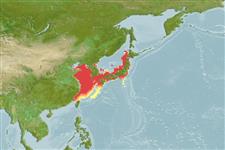
Tầng nổi; mức độ sâu 0 - 176 m (Tài liệu tham khảo 122799). Subtropical; 52°N - 29°N, 117°E - 142°E (Tài liệu tham khảo 121705)
Northwest Pacific: endemic to the East Asian Marginal Seas.
Chiều dài lúc trưởng thành đầu tiên / Bộ gần gũi / Khối lượng (Trọng lượng) / Tuổi
Chín muồi sinh dục: Lm ? range ? - ? cm Max length : 200 cm WD con đực/không giới tính; (Tài liệu tham khảo 99323); Khối lượng cực đại được công bố: 200.0 kg (Tài liệu tham khảo 3010); Tuổi cực đại được báo cáo: 1.00 các năm (Tài liệu tham khảo 100320)
One of the largest jellyfish species (Ref. 3010). Occurrence of jellyfish bloom has threatened the fisheries in Japan since early 2000s, possibly because of global warming - note that the growth of medusae are dependent on high temperatures (Ref. 100320). Occurs in semi-enclosed basins of marginal seas (Ref. 122853) and also found offshore (Ref. 122855). Before the chitin-covered podocysts develop into adults, they remain dormant for at least 6 years. Jellyfish blooms occur by mass excystment of these podocysts upon exposure to high temperatures (Ref. 100312).
Life cycle: Fertilized egg develops into a planula larva after 1 day. Planula swims for 4 to 8 days until it becomes a translucent, whitish and dome-shaped scyphistoma and settles at the bottom. Becomes a fully-developed scyphistoma after 10 to 20 days of settlement. Also exhibits asexual reproduction by means of podocyst formation (as many as 18 podocysts on a single original scyphistoma within 7 days to 3 months). Scyphistoma colony develops from podocyst of original scyphistoma within 6 months at 18°C. Fully-developed scyphistoma develops into a strobila after a day and becomes a liberated ephyra with 5 to 7 days. Becomes a fully-developed metaphyra within 30 days of post-liberation and becomes a young medusa within 40 to 50 days of post-liberation (Ref. 3004). Furthermore, ephyrae are released into the plankton during early summer. After subsequent sexual reproduction, the medusae die during winter. The life span of the medusae is less than a year (Ref. 100320).
Kawahara, M., S.-I. Uye, K. Ohtsu and H. Iizumi 2006 Unusual population explosion of the giant jellyfish Nemopilema nomurai (Scyphozoa: Rhizostomeae). Mar. Ecol. Prog. Ser. 307:161-173. (Tài liệu tham khảo 3004)
Tình trạng Sách đỏ IUCN
(Tài liệu tham khảo 130435: Version 2025-2 (Global))
tình trạng CITES (Tài liệu tham khảo 108899)
Not Evaluated
CMS (Tài liệu tham khảo 116361)
Not Evaluated
Mối đe dọa đối với con người
Harmless
Sử dụng của con người
Các nghề cá: tính thương mại
FAO - Publication: search | FishSource |
Các công cụ
Thêm thông tin
Sinh lý họcThành phần ô-xy
Liên quan đến con ngườiTem, tiền xu, v.v.
Các nguồn internet
Ước tính dựa trên mô hình
Sự dễ bị tổn thương của nghề đánh cá
(Tài liệu tham khảo 71543) |
Moderate to high vulnerability (50 of 100). |
Loại giá
(Tài liệu tham khảo 80766): |
Unknown. |