Gastropoda |
Neogastropoda |
Muricidae
Milieu: milieu / Klimaatzone / Diepte / verspreidingsgebied
Ecologie
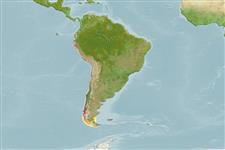
Benthic; diepte 0 - 40 m (Ref. 87801). Temperate, preferred 12°C (Ref. 107945); 6°S - 56°S, 81°W - 66°W (Ref. 111805)
Eastern Pacific and Western Atlantic: From Lobos de Afuera Island, Peru to Cape Horn, Chile.
Lengte bij maturiteit / Grootte / Gewicht / Leeftijd
Maturiteit: Lm ? range ? - ? cm Max length : 15.0 cm ShL mannelijk / geslacht onbekend; (Ref. 356)
It is found on rocky substrates, tidepools and rock crevices from the lower intertidal to a depth of 40 m (Ref. 87801).
Levenscyclus en paargedrag
Maturiteit | Voortplanting | Paaien | Eieren | Fecunditeit | Larven
Egg masses are composed of 243 to 256 egg capsules, each capsule containing 668 to 14,250 eggs. The capsules are found attached to a substrate by a stalk. Larva emerges from the egg and remains in the water column for a long period of time before settling (Ref. 87801).
Häussermann, V. and G. Försterra 2009 Marine benthic fauna of Chilean Patagonia. Santiago, Nature in Focus. 1000 p. (Ref. 87801)
Status op de Rode Lijst van het IUCN
(Ref. 130435: Version 2025-2 (Global))
CITES status (Ref. 108899)
Not Evaluated
Not Evaluated
Gevaar voor de mens
Gebruik door de mens
Visserij: commercieel
FAO - Aquaculture Systems: production searchvisserij: landings search; Publication: search | FishSource | Sea Around Us
Tools
Meer informatie
FysiologieZuurstofverbruik
Menselijk gerelateerdPostzegels, munten, diversen.
Internetbronnen
Schattingen op basis van modellen
Weerstandsvermogen
(Ref. 69278): |
Zeer laag, minimale populatieverdubbelingstijd meer dan 14 jaar (K=0.06) |
Kwetsbaarheid van de visserij
(Ref. 71543) |
Low to moderate vulnerability (31 of 100). |
Kwetsbaarheid voor het klimaat
(Ref. 125649) |
High vulnerability (58 of 100) |
Prijsklasse
(Ref. 80766): |
Low. |
Nutrients
|
Calcium = 126 [75, 177] mg/100g; Iron = 4.79 [1.67, 7.92] mg/100g; Protein = 15.9 [14.8, 16.9] %; Omega3 = 0.331 [0.263, 0.400] g/100g; Selenium = 57.8 [48.5, 67.2] μg/100g; VitaminA = 0 μg/100g; Zinc = 1.97 [0.92, 3.02] mg/100g (wet weight); based on nutrient studies. |