Gastropoda |
Neogastropoda |
Muricidae
Environnement : milieu / zone climatique / profondeur / gamme de distribution
Écologie
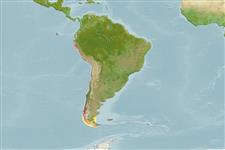
Benthic; profondeur 0 - 40 m (Réf. 87801). Temperate, preferred 12°C (Réf. 107945); 6°S - 56°S, 81°W - 66°W (Réf. 111805)
Eastern Pacific and Western Atlantic: From Lobos de Afuera Island, Peru to Cape Horn, Chile.
Longueur à la première maturité / Taille / Poids / Âge
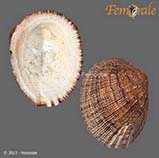
Maturité: Lm ? range ? - ? cm Max length : 15.0 cm ShL mâle / non sexé; (Réf. 356)
It is found on rocky substrates, tidepools and rock crevices from the lower intertidal to a depth of 40 m (Ref. 87801).
Cycle de vie et comportement reproducteur
Maturité | Reproduction | Frai | Œufs | Fécondité | Larves
Egg masses are composed of 243 to 256 egg capsules, each capsule containing 668 to 14,250 eggs. The capsules are found attached to a substrate by a stalk. Larva emerges from the egg and remains in the water column for a long period of time before settling (Ref. 87801).
Häussermann, V. and G. Försterra 2009 Marine benthic fauna of Chilean Patagonia. Santiago, Nature in Focus. 1000 p. (Réf. 87801)
Statut dans la liste rouge de l'IUCN
(Réf. 130435: Version 2025-2 (Global))
statut CITES (Réf. 108899)
Not Evaluated
Not Evaluated
Menace pour l'homme
Utilisations par l'homme
Pêcheries: commercial
FAO - Aquaculture Systems: production searchpêcheries: landings search; Publication: search | FishSource | Sea Around Us
Outils
Plus d'informations
Dynamique des populations PhysiologieConsommation d'oxygène
Liées à l'hommeTimbres, pièces de monnaie, divers
Sources Internet
Estimations basées sur des modèles
Résilience
(Ref. 69278): |
Très faible, temps minimum de doublement de population supérieur à 14 ans (K=0.06) |
Vulnérabilité de la pêche
(Réf. 71543) |
Low to moderate vulnerability (31 of 100). |
Vulnérabilité climatique
(Réf. 125649) |
High vulnerability (58 of 100) |
Catégorie de prix
(Réf. 80766): |
Low. |
Nutrients
|
Calcium = 126 [75, 177] mg/100g; Iron = 4.79 [1.67, 7.92] mg/100g; Protein = 15.9 [14.8, 16.9] %; Omega3 = 0.331 [0.263, 0.400] g/100g; Selenium = 57.8 [48.5, 67.2] μg/100g; VitaminA = 0 μg/100g; Zinc = 1.97 [0.92, 3.02] mg/100g (wet weight); based on nutrient studies. |