Octocorallia |
Scleralcyonacea |
Coralliidae
環境: 環境 / 氣候帶 / 深度上下限 / 配送範圍
生態學
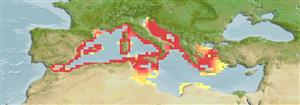
Sessile; 深度上下限 10 - 1016 m (參考文獻 66603), usually 10 - 100 m (參考文獻 358). Subtropical
Eastern Atlantic and the Mediterranean.
初熟時的長度 / 大小 / 重量 / 年齡
成熟度: Lm ? range ? - ? cm Max length : 3.0 cm COLD 雄魚/尚未辨別雌雄; (參考文獻 364)
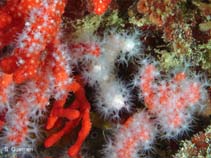
Arborescent colonies, with growth irregularly divided into all directions, provided with a Hard skeleton calcareous: can exceed 50 cm, but in general less developed. The surface of the ramifications is not smooth. Polyp: reach the diameter of 0.15 cm; they are white and translucent, the cortical fabric being of red color, seldom white or yellow. The skeleton is highly colored of red; more rarely of pink; dark; white red or to black (Ref. 358). Certain colonies: 20 cm height, but intensive fishing makes disappear the largest specimens. Diameter of the base: 3 cm at the largest specimens (Ref. 364).
Hard skeleton calcareous: can exceed 50 cm, but in general less developed. Polyp: reach the diameter of 0.15 cm. Depth: commonly 10 m of depth; currently, it is necessary to go down beyond the 30 m, generally even 40 m, and until several hundred meters of depth (Ref. 358). Maximum depth and common maximum depth from Ref. 122525. Habitat: Found in the infra- and circalittoral zones as well as bathyal zones (Ref. 85338). Sites little exposed to the solar rays: lower level of rock overhangs, anfractuosities and excavations, rock walls located at great depth (Ref. 358); conditioned by two essential criteria: the weak luminosity and the substrate. One finds it in theory only on the bed rock under conditions of reduced illumination. At the surface levels, it characterizes the biocenoses semi-obscure caves. Low, one meets it on rock cliffs or sproutings. Harvests, made more and more deeply, restrict its bathymetric distribution. (Ref. 364). Found on cave walls, vertical cliffs and overhangs (Ref. 66603). Exposure to high temperatures beyond 24°C appears to have a critical mortality effect, decreasing polyp activity and calcification rates (Ref. 129072).
生命週期和交配行為
成熟度 | 繁殖 | 產卵場 | 卵 | 孕卵數 | 仔魚
Members of the class Anthozoa are either gonochoric or hermaphroditic. Mature gametes are shed into the coelenteron and spawned through the mouth. Life cycle: The zygote develops into a planktonic planula larva. Metamorphosis begins with early morphogenesis of tentacles, septa and pharynx before larval settlement on the aboral end.
主要參考資料
參考文獻 | 合作者 | 合作者
Göthel, H. 1992 Guide de la faune sous-marine: La Méditerranée. Invertébrés marins et poissons. Eygen Ulmer GmbH & Co. 318 p. (參考文獻 358)
IUCN 瀕危狀態
(參考文獻 130435: Version 2025-2 (Global))
CITES狀態 (參考文獻 108899)
Not Evaluated
Not Evaluated
對人類具威脅
人類使用
漁業: 商業性
FAO - 漁業: 魚種描繪, landings search; Publication: search | FishSource | 周邊海洋
工具
更多資訊
營養生態學食物項目(獵物)
食性組成
食物消耗量
捕食者
網路資源
基於模型的估計
回復力
(Ref. 69278): |
低的, 最小族群倍增時間4.5 - 14 年 (K=0.06) |
釣魚的脆弱性
(參考文獻 71543) |
Moderate to high vulnerability (46 of 100). |
價格種類
(參考文獻 80766): |
Unknown. |