Octocorallia |
Scleralcyonacea |
Coralliidae
पर्यावरण: पर्यावरण / जलवायु क्षेत्र / गहराई सीमा / वितरण सीमा
पारिस्थितिकी
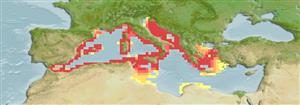
Sessile; गहराई सीमा 10 - 1016 m (संदर्भ 66603), usually 10 - 100 m (संदर्भ 358). Subtropical
Eastern Atlantic and the Mediterranean.
प्रथम परिपक्वता पर लंबाई / आकार / वज़न / आयु
परिपक्व अवधि: Lm ? range ? - ? cm Max length : 3.0 cm COLD पुल्लिंग / अलिंग; (संदर्भ 364)
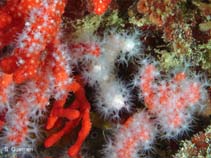
Arborescent colonies, with growth irregularly divided into all directions, provided with a Hard skeleton calcareous: can exceed 50 cm, but in general less developed. The surface of the ramifications is not smooth. Polyp: reach the diameter of 0.15 cm; they are white and translucent, the cortical fabric being of red color, seldom white or yellow. The skeleton is highly colored of red; more rarely of pink; dark; white red or to black (Ref. 358). Certain colonies: 20 cm height, but intensive fishing makes disappear the largest specimens. Diameter of the base: 3 cm at the largest specimens (Ref. 364).
Hard skeleton calcareous: can exceed 50 cm, but in general less developed. Polyp: reach the diameter of 0.15 cm. Depth: commonly 10 m of depth; currently, it is necessary to go down beyond the 30 m, generally even 40 m, and until several hundred meters of depth (Ref. 358). Maximum depth and common maximum depth from Ref. 122525. Habitat: Found in the infra- and circalittoral zones as well as bathyal zones (Ref. 85338). Sites little exposed to the solar rays: lower level of rock overhangs, anfractuosities and excavations, rock walls located at great depth (Ref. 358); conditioned by two essential criteria: the weak luminosity and the substrate. One finds it in theory only on the bed rock under conditions of reduced illumination. At the surface levels, it characterizes the biocenoses semi-obscure caves. Low, one meets it on rock cliffs or sproutings. Harvests, made more and more deeply, restrict its bathymetric distribution. (Ref. 364). Found on cave walls, vertical cliffs and overhangs (Ref. 66603). Exposure to high temperatures beyond 24°C appears to have a critical mortality effect, decreasing polyp activity and calcification rates (Ref. 129072).
जीवन चक्र और संभोग व्यवहार
परिपक्व अवधि | पुनरुत्पत्ति | मछलीऔ का अंडे देना | अंडे | उपजाऊपन | लार्वा
Members of the class Anthozoa are either gonochoric or hermaphroditic. Mature gametes are shed into the coelenteron and spawned through the mouth. Life cycle: The zygote develops into a planktonic planula larva. Metamorphosis begins with early morphogenesis of tentacles, septa and pharynx before larval settlement on the aboral end.
Göthel, H. 1992 Guide de la faune sous-marine: La Méditerranée. Invertébrés marins et poissons. Eygen Ulmer GmbH & Co. 318 p. (संदर्भ 358)
आईयूसीएन रेड लिस्ट स्थिति
(संदर्भ 130435: Version 2025-2 (Global))
CITES स्थिति (संदर्भ 108899)
Not Evaluated
CMS (संदर्भ 116361)
Not Evaluated
मनुष्यों के लिए ख़तरा
मानव उपयोग
मात्स्यिकी: व्यापारिक
FAO - मात्स्यिकी: प्रजातियों की प्रोफ़ाइल, landings search; Publication: search | FishSource | हमारे चारों ओर समुद्र
साधन
अधिक जानकारी
ट्रॉफिक पारिस्थितिकीखाद्य पदार्थ (शिकार)
संघटक आहार
आहार खपत
परभक्षी
जीवन चक्रपुनरुत्पत्तिपरिपक्व अवधिउपजाऊपनमछलीऔ का अंडे देनाअंडेअंडे का विकासलार्वा फिजियोलॉजीप्राणवायु की खपत
इंटरनेट स्रोत
मॉडल पर आधारित अनुमान
लौटाव
(Ref. 69278): |
निम्न, न्यूनतम जनसंख्या दुगनी होने का समय 4.5 - 14 वर्ष। (K=0.06) |
मछली पकड़ने की भेद्यता
(संदर्भ 71543) |
Moderate to high vulnerability (46 of 100). |
मूल्य श्रेणी
(संदर्भ 80766): |
Unknown. |