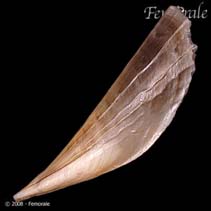
Bivalvia |
Ostreida |
Pinnidae
Miljö: miljö / Klimatzon / djupintervall / distributionsområde
Ekologi
Benthic; djupintervall 0 - 50 m (Ref. 348). Tropical; 35°N - 37°S, 29°E - 154°W
Indo-West Pacific: from East and southeast Africa, including Madagascar, Mauritius Island, the Red Sea and the Persian Gulf, to New Caledonia; north to Japan and south to South Australia. Generally absent from oceanic islands of the central Indian Ocean and the tropical West Pacific, but sporadically found in Hawaii.
Längd vid första mognad / Storlek / Vikt / Ålder
Könsmognad: Lm ? range ? - ? cm Max length : 50.0 cm SHL hane/ej könsbestämd; (Ref. 348); common length : 40.0 cm SHL hane/ej könsbestämd; (Ref. 348); rapporterad maxålder: 18 år (Ref. 107096)
Species of minor economic importance, and collected for subsistence fisheries (Ref. 348). Maximum depth from Ref. 101118. Embedded in muddy sand and reef flats, in littoral and adjacent subtidal shallow waters to depths of about 10 m (Ref. 348). Also found buried in hard substratum and associated with seagrass beds (Ref. 101119). Planktonic larval stage probably short, hence a range restricted to the shores of continental areas and adjacent island (Ref. 348). Small benthic Pinna may likely depend on dissolved organic matter for nutrition (Ref. 107096).
Livscykel och parningsbeteende
Könsmognad | Reproduktion | Lek | Ägg | Fekunditet | Larver
Planktonic larval stage (Ref. 348).
Poutiers, J.M. 1998 Bivalves. Acephala, Lamellibranchia, Pelecypoda. p. 123-362. In Carpenter, K. E. and V. H. Niem. 1998. FAO species identification guide for fishery purposes. The living marine resources of the Western Central Pacific. Volume 1. Seaweeds, corals, bivalves, and gastropods. Rome, FAO. (Ref. 348)
Status på IUCN:s rödlista
(Ref. 130435: Version 2025-2 (Global))
CITES-status (Ref. 108899)
Not Evaluated
Not Evaluated
Hot mot människor
Mänskliga användningsområden
Fiskeri: kommersiell
FAO - Publication: search | FishSource | Havet omkring oss
Verktyg
Ytterligare information
Trofisk ekologiLivsmedelsartiklar (preys)
Födosammansättning
Födointag
Predatorer
LivscykelReproduktionKönsmognadFekunditetLekÄggUtveckling av äggLarver MänniskorelateradFrimärken, mynt, diverse.
Internet-källor
Uppskattningar baserade på modeller
Resiliens
(Ref. 69278): |
Hög, lägsta populationsfördubblingstid mindre än 15 månader (K=0.88) |
Rate of population increase
|
Prior r = 0.84, 95% CL = 0.56 - 1.27, Based on 1 data-limited stock assessment. |
Sårbarhet i fisket
(Ref. 71543) |
Moderate vulnerability (38 of 100). |
Priskategori
(Ref. 80766): |
Unknown. |
Nutrients
|
Calcium = 149 [71, 228] mg/100g; Iron = 8.53 [1.95, 15.11] mg/100g; Protein = 9.88 [8.64, 11.12] %; Omega3 = 0.313 [0.202, 0.423] g/100g; Selenium = 61 [50, 72] μg/100g; VitaminA = 0 μg/100g; Zinc = 2.04 [0.56, 3.51] mg/100g (wet weight); based on nutrient studies. |