Bivalvia |
Arcida |
Arcidae
Environnement : milieu / zone climatique / profondeur / gamme de distribution
Écologie
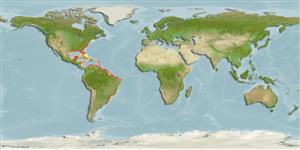
Benthic; profondeur 0 - 68 m (Réf. 104365). Tropical, preferred 25°C (Réf. 107945); 43°N - 35°S, 98°W - 33°W (Réf. 3446)
Western Atlantic: from Cape Cod, Massachusetts, to the West Indies and Brazil.
Longueur à la première maturité / Taille / Poids / Âge
Maturité: Lm ? range ? - ? cm Max length : 7.6 cm SHL mâle / non sexé; (Réf. 78146)
Description synthétique
Morphologie
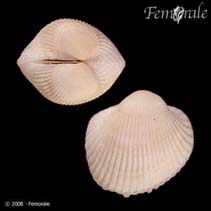
Equivalved, oval in shape. Size range: 2.8-7.6 cm shell length. Shell length to height ratio = 1.16 (Ref. 78148). Shell depth reaching 70% of height (Ref. 78152).
In the USA, this species remains a potential fishery resource. From the late 1990s to early 2000s, wild stocks of this species are the target of a small-scale fishery in North Carolina (Ref. 78154) and the eastern coast of Virginia with exports primarily as ethnic food to Chicago, New York, Los Angeles and Washington D.C. (Ref. 78152). Occurs at depths ranging from the low-tide line to 3 m (Ref. 78147). Found in an estuarine environment (Ref. 104365). Found in most soft bottoms but prefers fine sand (Ref. 78148). Is a suspension feeder, discreetly motile while feeding with its ctenidia, i.e., the comb-like structure functioning as gill in bivalve mollusks (Ref. 78149). In general, suspension feeding bivalves mainly depend on phytoplankton and detritus material for nutrition (Ref. 107088).
Cycle de vie et comportement reproducteur
Maturité | Reproduction | Frai | Œufs | Fécondité | Larves
Sexes are separate with low incidence of hermaphrodism (2.17%). Males dominant (m/f=2.68). Peak in gonadal pattern in late spring to early summer (45% ripe in May) and a minor peak in winter (21% ripe in December). Dribble spawning likely strategy to extend spawning period and increase reproductive success.
Turgeon, D.D., J.F. Quinn Jr., A.E. Bogan, E.V. Coan, F.G. Hochberg, W.G. Lyons, P.M. Mikkelsen, R.J. Neves, C.F.E. Roper, G. Rosenberg, B. Roth, A. Scheltema, F.G. Thompson, M. Vecchione and J.D. Willams 1998 Common and scientific names of aquatic invertebrates from the United States and Canada: Mollusks, 2nd ed. American Fisheries Society (Special publication 26), Bethesda, Maryland. 526 p. (Réf. 1667)
Statut dans la liste rouge de l'IUCN
(Réf. 130435: Version 2025-2 (Global))
statut CITES (Réf. 108899)
Not Evaluated
Not Evaluated
Menace pour l'homme
Harmless
Utilisations par l'homme
Pêcheries: intérêt commercial mineur; Aquaculture: expérimental
FAO - pêcheries: landings search; Publication: search | FishSource | Sea Around Us
Outils
Plus d'informations
Dynamique des populations PhysiologieConsommation d'oxygène
Liées à l'hommeTimbres, pièces de monnaie, divers
Sources Internet
Estimations basées sur des modèles
Résilience
(Ref. 69278): |
Haut, temps minimum de doublement de population inférieur à 15 mois (K=0.45; tm=5) |
Vulnérabilité de la pêche
(Réf. 71543) |
Moderate vulnerability (37 of 100). |
Vulnérabilité climatique
(Réf. 125649) |
Moderate to high vulnerability (55 of 100) |
Catégorie de prix
(Réf. 80766): |
Medium. |
Nutrients
|
Calcium = 149 [71, 228] mg/100g; Iron = 8.53 [1.95, 15.11] mg/100g; Protein = 9.88 [8.64, 11.12] %; Omega3 = 0.313 [0.202, 0.423] g/100g; Selenium = 61 [50, 72] μg/100g; VitaminA = 0 μg/100g; Zinc = 2.04 [0.56, 3.51] mg/100g (wet weight); based on nutrient studies. |