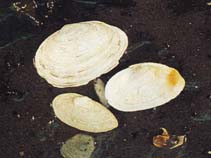
Bivalvia |
Myida |
Myidae
Lingkungan: lingkungan / zona iklim / kisaran kedalaman / jangkauan distribusi
Ekologi
Benthic; payau; kisaran kedalaman 0 - 192 m (Acuan 78574), usually 0 - 25 m (Acuan 75831). Temperate, preferred 9°C (Acuan 107945); 48°N - 33°N, 79°W - 56°W
Northwest Atlantic: from St. Pierre Miquelon to North Carolina. Introduced in the North Sea and European waters including the Black, Baltic, Wadden, White and Mediterranean seas, and Eastern Pacific from Alaska to San Francisco.
Panjang pada saat jatuh tempo pertama / Ukuran / Berat / umur
Kematangan: Lm ? range ? - ? cm Max length : 10.0 cm TL jantan/; (Acuan 7726); Umur maksimum dilaporkan: 8 Tahun (Acuan 2823)
Minimum depth from Ref. 101279. Maximum depth recorded is 329 m (Ref. 101279). Lives in burrows in sand, mud, sandy mud and sandy gravels from the mid shore to the shallow sublittoral, sometimes to a depth of 192 m (Refs. 78574, 137850). Commonly found in estuarine areas, buried in substrate 10 to 20 cm deep (Ref. 95344). In the Vainameri (north-eastern Baltic Sea), abundant in silty substrate (Ref. 95753). Deposit/filter feeders (Ref. 95728). Identified as an ecologically important benthic species of the Baltic Sea, mainly as part of the food base of fishes and its contribution to biofiltration and biosedimentation processes (Ref. 95774). A microvore that feeds on organic detritus (Ref. 96352). Found both in intertidal mudflat and estuary (Refs. 2823, 137850).
Siklus hidup dan perilaku kawin
Kematangan | Reproduksi, perkembang biakan | Pemijahan | telur-telur | Fekunditas | Larva
Members of the class Bivalvia are mostly gonochoric, some are protandric hermaphrodites. Life cycle: Embryos develop into free-swimming trocophore larvae, succeeded by the bivalve veliger, resembling a miniature clam.
rujukan utama
Acuan | Koordinator | mitra
Harvey-Clark, C. 1997 Eastern tidepool and reef: north-central Atlantic marinelife guide. Hancock House Publishers, 64pp. (Acuan 7726)
Status IUCN Red List
(Acuan 130435: Version 2025-2 (Global))
status CITES (Acuan 108899)
Not Evaluated
Not Evaluated
ancaman kepada manusia
penggunaan manusia
Perikanan: komersial
FAO - Aquaculture Systems: production searchPerikanan: landings search; Publication: search | FishSource | Laut di Sekitar Kita
Alat, peralatan
informasi lanjut
FisiologiKonsumsi oksigen
Yang berhubungan dengan manusiaPerangko, koin, dll.
Sumber internet
Estimasi berdasarkan model
Daya lenting
(Ref. 69278): |
sedang, Waktu penggandaan populasi minimum 1.4 - 4.4 tahun (K=0.14-0.48; tmax=8) |
Kerentanan Penangkapan Ikan
(Acuan 71543) |
Moderate vulnerability (36 of 100). |
Kerentanan Iklim
(Acuan 125649) |
Moderate to high vulnerability (51 of 100) |
kategori harga
(Acuan 80766): |
High. |
Nutrients
|
Calcium = 149 [71, 228] mg/100g; Iron = 8.53 [1.95, 15.11] mg/100g; Protein = 9.88 [8.64, 11.12] %; Omega3 = 0.313 [0.202, 0.423] g/100g; Selenium = 61 [50, 72] μg/100g; VitaminA = 0 μg/100g; Zinc = 2.04 [0.56, 3.51] mg/100g (wet weight); based on nutrient studies. |