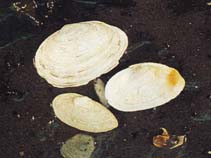
Bivalvia |
Myida |
Myidae
Ambiente: milieu / zona climatica / distribuzione batimetrica / gamma di distribuzione
Ecologia
Benthic; salmastro; distribuzione batimetrica 0 - 192 m (Fonte Biblio. 78574), usually 0 - 25 m (Fonte Biblio. 75831). Temperate, preferred 9°C (Fonte Biblio. 107945); 48°N - 33°N, 79°W - 56°W
Northwest Atlantic: from St. Pierre Miquelon to North Carolina. Introduced in the North Sea and European waters including the Black, Baltic, Wadden, White and Mediterranean seas, and Eastern Pacific from Alaska to San Francisco.
Lunghezza alla prima maturità / Dimensione / Peso / Età
Maturità: Lm ? range ? - ? cm Max length : 10.0 cm TL maschio/sesso non determinato; (Fonte Biblio. 7726); Età massima riportata: 8 anni (Fonte Biblio. 2823)
Minimum depth from Ref. 101279. Maximum depth recorded is 329 m (Ref. 101279). Lives in burrows in sand, mud, sandy mud and sandy gravels from the mid shore to the shallow sublittoral, sometimes to a depth of 192 m (Refs. 78574, 137850). Commonly found in estuarine areas, buried in substrate 10 to 20 cm deep (Ref. 95344). In the Vainameri (north-eastern Baltic Sea), abundant in silty substrate (Ref. 95753). Deposit/filter feeders (Ref. 95728). Identified as an ecologically important benthic species of the Baltic Sea, mainly as part of the food base of fishes and its contribution to biofiltration and biosedimentation processes (Ref. 95774). A microvore that feeds on organic detritus (Ref. 96352). Found both in intertidal mudflat and estuary (Refs. 2823, 137850).
Ciclo vitale e comportamento di accoppiamento
Maturità | Riproduzione | Deposizione | Uova | Fecondità | Larve
Members of the class Bivalvia are mostly gonochoric, some are protandric hermaphrodites. Life cycle: Embryos develop into free-swimming trocophore larvae, succeeded by the bivalve veliger, resembling a miniature clam.
Harvey-Clark, C. 1997 Eastern tidepool and reef: north-central Atlantic marinelife guide. Hancock House Publishers, 64pp. (Fonte Biblio. 7726)
Stato della Lista Rossa IUCN
(Fonte Biblio. 130435: Version 2025-2 (Global))
Stato della CITES (Fonte Biblio. 108899)
Not Evaluated
CMS (Fonte Biblio. 116361)
Not Evaluated
Minaccia per l'uomo
Usi umani
Pesca: commerciale
FAO - Aquaculture Systems: production searchpesca: landings search; Publication: search | FishSource | Sea Around Us
Strumenti
Informazioni ulteriori
Dinamica della popolazione Ciclo di vitaRiproduzioneMaturitàFeconditàDeposizioneUovaSviluppo delle uovaLarve FisiologiaConsumo di ossigeno
Legato all'uomoFrancobolli, monete, materiale vario.
Fonti Internet
Stime basate su modelli
Resilienza
(Ref. 69278): |
Medio, tempo minimo di raddoppiamento della popolazione 1.4 - 4.4 anni (K=0.14-0.48; tmax=8) |
Vulnerabilità della pesca
(Fonte Biblio. 71543) |
Moderate vulnerability (36 of 100). |
Vulnerabilità climatica
(Fonte Biblio. 125649) |
Moderate to high vulnerability (51 of 100) |
Categoria di prezzo
(Fonte Biblio. 80766): |
High. |
Nutrients
|
Calcium = 149 [71, 228] mg/100g; Iron = 8.53 [1.95, 15.11] mg/100g; Protein = 9.88 [8.64, 11.12] %; Omega3 = 0.313 [0.202, 0.423] g/100g; Selenium = 61 [50, 72] μg/100g; VitaminA = 0 μg/100g; Zinc = 2.04 [0.56, 3.51] mg/100g (wet weight); based on nutrient studies. |