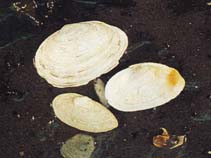
Bivalvia |
Myida |
Myidae
Entorno: milieu / zona climática / rango de profundidad / gama de distribución
Ecología
Benthic; salobre; rango de profundidad 0 - 192 m (Referencia 78574), usually 0 - 25 m (Referencia 75831). Temperate, preferred 9°C (Referencia 107945); 48°N - 33°N, 79°W - 56°W
Northwest Atlantic: from St. Pierre Miquelon to North Carolina. Introduced in the North Sea and European waters including the Black, Baltic, Wadden, White and Mediterranean seas, and Eastern Pacific from Alaska to San Francisco.
Longitud en la primera madurez / Tamaño / Peso / Edad
Madurez: Lm ? range ? - ? cm Max length : 10.0 cm TL macho / no sexado; (Referencia 7726); edad máxima reportada: 8 años (Referencia 2823)
Minimum depth from Ref. 101279. Maximum depth recorded is 329 m (Ref. 101279). Lives in burrows in sand, mud, sandy mud and sandy gravels from the mid shore to the shallow sublittoral, sometimes to a depth of 192 m (Refs. 78574, 137850). Commonly found in estuarine areas, buried in substrate 10 to 20 cm deep (Ref. 95344). In the Vainameri (north-eastern Baltic Sea), abundant in silty substrate (Ref. 95753). Deposit/filter feeders (Ref. 95728). Identified as an ecologically important benthic species of the Baltic Sea, mainly as part of the food base of fishes and its contribution to biofiltration and biosedimentation processes (Ref. 95774). A microvore that feeds on organic detritus (Ref. 96352). Found both in intertidal mudflat and estuary (Refs. 2823, 137850).
Ciclo vital y comportamiento de apareamiento
Madurez | Reproducción | Puesta | Huevos | Fecundidad | Larva
Members of the class Bivalvia are mostly gonochoric, some are protandric hermaphrodites. Life cycle: Embryos develop into free-swimming trocophore larvae, succeeded by the bivalve veliger, resembling a miniature clam.
Harvey-Clark, C. 1997 Eastern tidepool and reef: north-central Atlantic marinelife guide. Hancock House Publishers, 64pp. (Referencia 7726)
Situación en la Lista Roja de la UICN
(Referencia 130435: Version 2025-2 (Global))
Estatus CITES (Referencia 108899)
Not Evaluated
CMS (Referencia 116361)
Not Evaluated
Amenaza para el ser humano
Usos humanos
Pesquerías: comercial
FAO - Aquaculture Systems: production searchpesquerías: landings search; Publication: search | FishSource | Sea Around Us
Herramientas
Más información
Ciclo de vidaReproducciónMadurezFecundidadPuestaHuevosDesarrollo de los huevosLarva FisiologíaConsumo del oxígeno
Relacionados con el ser humanoSellos, monedas, varios
Fuentes de Internet
Estimaciones basadas en modelos
Resiliencia
(Ref. 69278): |
Medio, población duplicada en un tiempo mínimo de 1.4-4.4 años (K=0.14-0.48; tmax=8) |
Vulnerabilidad pesquera
(Referencia 71543) |
Moderate vulnerability (36 of 100). |
Vulnerabilidad climática
(Referencia 125649) |
Moderate to high vulnerability (51 of 100) |
Categoría de precios
(Referencia 80766): |
High. |
Nutrients
|
Calcium = 149 [71, 228] mg/100g; Iron = 8.53 [1.95, 15.11] mg/100g; Protein = 9.88 [8.64, 11.12] %; Omega3 = 0.313 [0.202, 0.423] g/100g; Selenium = 61 [50, 72] μg/100g; VitaminA = 0 μg/100g; Zinc = 2.04 [0.56, 3.51] mg/100g (wet weight); based on nutrient studies. |