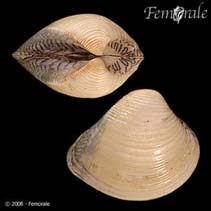
Bivalvia |
Venerida |
Veneridae
Milieu: milieu / Klimaatzone / Diepte / verspreidingsgebied
Ecologie
Benthic; brak water; diepte 0 - 10 m (Ref. 83435). Tropical; 21°N - 35°S, 89°W - 34°W
Western Atlantic: Antilles, Caribbean Sea, Brazil to Uruguay.
Lengte bij maturiteit / Grootte / Gewicht / Leeftijd
Maturiteit: Lm ?, range 1 - ? cm Max length : 3.7 cm SHL mannelijk / geslacht onbekend; (Ref. 130712); max. gerapporteerde leeftijd: 3.00 Jaren (Ref. 104267)
Found in the intertidal zone to a depth of 1.5 m (Ref. 104267). Lives slightly buried in muddy sands of shallow water environments, particularly in mangrove lagoons (Ref. 81903). Adults prefer to settle in areas with fine or coarse sand where conditions are harsher during low tide (Ref. 104267). Strictly a filter-feeder (Ref. 104242). Suspension feeder (Ref. 105167). In general, suspension feeding bivalves mainly depend on phytoplankton and detritus material for nutrition (Ref. 107088). Sensitive to salinity variations but resistant to hypoxic conditions (Ref. 104267). Associated with a crab (Refs. 104147, 105309), bivalve and polychaetes (Ref.105309).
Levenscyclus en paargedrag
Maturiteit | Voortplanting | Paaien | Eieren | Fecunditeit | Larven
Members of the class Bivalvia are mostly gonochoric, some are protandric hermaphrodites. Life cycle: Embryos develop into free-swimming trocophore larvae, succeeded by the bivalve veliger, resembling a miniature clam (Ref. 833).
Barreira, C.A.R. and M.L.R. Araújo 2005 Ciclo reprodutivo de Anomalocardia brasiliana (Gmelin, 1791) (Mollusca, Bivalvia, Veneridae) na Praia do Canto da Barra, Fortim, Ceará, Brasil. Boletim do Instituto de Pesca, São Paulo 31(1):9-20. (Ref. 81737)
Status op de Rode Lijst van het IUCN
(Ref. 130435: Version 2025-2 (Global))
CITES status (Ref. 108899)
Not Evaluated
Not Evaluated
Gevaar voor de mens
Gebruik door de mens
Visserij: commercieel
FAO - Publication: search | FishSource |
Tools
Meer informatie
FysiologieZuurstofverbruik
Menselijk gerelateerdPostzegels, munten, diversen.
Internetbronnen
Schattingen op basis van modellen
Weerstandsvermogen
(Ref. 69278): |
Hoog, minimale populatieverdubbelingstijd minder dan 15 maanden (K=0.69; tmax=3) |
Kwetsbaarheid van de visserij
(Ref. 71543) |
Low vulnerability (18 of 100). |
Prijsklasse
(Ref. 80766): |
Medium. |