Polychaeta |
Echiuroidea |
Bonelliidae
Окружающая среда: среда / климатическая зона / пределы глубины / диапазон распространения
экология
Benthic. Subtropical
Arctic, Northeast Atlantic and the Mediterranean: Sweden, Norway, Ireland and Malta.
Длина при первой зрелости / Размер / Вес / Возраст
половая зрелость: Lm ? range ? - ? cm Max length : 15.0 cm TL самец/пол неопределен; (ссылка 358)
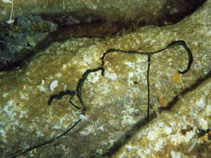
The worm is provided with an appendix; is located on the head; or misleads, which, deployed, conferred on the species a size of about 150 cm, forked in its end, of a scale of 50 cm and whose edges are corrugated. Body: plum shape; 15 cm length. Males and females have an extremely different morphology. The males: 0.1- 0.3 cm length: they have neither horn nor intestine; and live in parasite in the esophagus of the female: only one can lodge some up to 85 (Ref. 358).
Infralittoral zone; lives on hard bottoms, (Ref. 772) in anfractuosities and excavations on hard funds, interstices between stones and rollers. Females always seen occupying anfractuosities of rocks or all other benthic niche. For nourishment, they use horns equipped to palpate ground and consume microorganisms or organic matter of various origins. Nutritive particle coated with mucus before being introduced (Ref. 358). Sex of the larvae swimmer not given of start: if one larva comes into contact with horn of female, it is introduced as food particle; inside body of this female, hormonal processes make larva evolve into nanifié male. If on the contrary it manages to take refuge in anfractuosities, larva evolves into female. This mode of development guarantees a balanced population (Ref. 358). Habitat: Anfractuosities and excavations on hard funds, interstices between the stones and rollers. Biology: at the Bonellia sp. kind, the sexual dimorphism is very marked: males and females have an extremely different morphology. It is always the female of the species which one sees in nature, occupying an anfractuosities of the rock or all other benthic niche. To nourish themselves: Uses the horn equipped to palpate the ground and to consume of them the micro-organisms or the organic matter of various origins. Nutritive particles: Coated with mucus before being introduced. The disturbed animal retracts this body completely. The males: 0.1 to 0.3 cm length: they have neither horn nor intestine; female: only one can lodge some up to 85 (Ref. 358). Lives on hard bottoms in the infralittoral zone (Ref. 772).
Жизненный цикл и брачное поведение
половая зрелость | размножение | нерест | икра | Плодовитость | личинки
The sex of the larvae swimmer is not given of start: if one as of the these larvae comes into contact with the horn of a female, it will be introduced as well as a food particle; inside the body of this female, hormonal processes make evolve/move this larva in nanifié male. If on the contrary it manages to take refuge in an anfractuosities, the larva evolves/moves in female. This mode of development guarantees a balanced population (Ref. 358).
Основная ссылка
ссылки | координатор | соавторы
Göthel, H. 1992 Guide de la faune sous-marine: La Méditerranée. Invertébrés marins et poissons. Eygen Ulmer GmbH & Co. 318 p. (ссылка 358)
Статус Красного Списка МСОП
(ссылка 130435: Version 2025-2 (Global))
Статус СИТЕС (ссылка 108899)
Not Evaluated
CMS (ссылка 116361)
Not Evaluated
Угроза для людей
Использование человеком
FAO - Publication: search | FishSource |
инструменты
дополнительная информация
Трофическая экологияПищевые предметы (добыча)
состав пищи
потребление пищи
хищники
Динамика численности населенияростМакс. возраст / размерОтношение длины к весу.Отношение длины к длине.Размерный составПреобразование массычисленность Жизненный циклразмножениеполовая зрелостьПлодовитостьнерестикраРазвитие икрыличинки ФизиологияПотребление кислорода
Связанные с человекомМарки, монеты и прочее.
Информационно-просветительская работа
ресурсы в Интернет
Оценки, основанные на моделях
Уязвимость рыбной ловли
(ссылка 71543) |
Low vulnerability (10 of 100). |
Категория цены
(ссылка 80766): |
Unknown. |