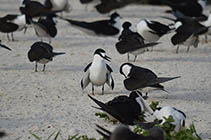
Aves |
Charadriiformes |
Laridae
Umwelt: Milieu / Klimazone / Tiefenbereich / Verbreitungsgebiet
Ökologie
Pelagisch. Tropical; 35°N - 40°S (Ref. 96995)
Indo-Pacific, Atlantic Ocean and the Mediterranean.
Länge bei der ersten Reifung / Größe / Gewicht / Alter
Geschlechtsreife: Lm ? range ? - ? cm Max length : 45.0 cm TL Männchen/unbestimmt; (Ref. 8812); max. veröff. Gewicht: 180.00 g (Ref. 356); max. veröff. Alter: 36 Jahre (Ref. 8545)
Culmen: 4.53 cm; tarsus: 2.52 cm; wing: 30.5 cm.
Total Length: 43 to 45 cm; Wingspan: 86 to 94 cm (Ref. 8812). Pelagic (Ref. 122680). Coastal and oceanic islands, and offshore (Ref. 356). In beach, shoreline and pelagic zone (Ref. 116102). Pantropic, pelagic species. Strong flyer, high over the ocean. Forms large breeding colonies on tropical and subtropical islands on sand, coral and rock, with or without vegetation. Forages in flocks (Ref. 84934). Remains 10 to 20 m above water then descends and wheels in circles before grabbing its food (Ref. 356). Feeding techniques: air dipping and contact dipping from the water surface (Refs. 356, 96995). Diet consists of squid, goatfish, flyingfish and mackerel scad (Ref. 122680). Does not plunge dive and rarely stays long in water as plumage is not waterproof. Colonies may suffer heavy losses of eggs by predatory cats (Ref. 84934).
Birds go to the island at night, 3 months before laying. Hatching peaks in the middle of April. Most fledging shows in June and leave the island at the beginning of August while the adults leave at the end of August (Ref. 96995).
Lepage, D. 2007 Avibase -the World Bird Database. http://www.bsc-eoc.org/avibase/avibase.jsp [accessed 09/07/2007]. (Ref. 7816)
IUCN Rote Liste Status
(Ref. 130435: Version 2025-2 (Global))
CITES Status (Ref. 108899)
Not Evaluated
Not Evaluated
Bedrohung für Menschen
Nutzung durch Menschen
FAO - Publication: search | FishSource |
Tools
Mehr Information
PhysiologieSauerstoffverbrauch
MenschenbezogenBriefmarken, Münzen, Verschiedenes.
Internet Quellen
Schätzungen auf der Grundlage von Modellen
Widerstandsfähigkeit
(Ref. 69278): |
hoch, Verdopplung der Population dauert weniger als 15 Monate. (K=5.28; tm=3; tmax=36) |
Anfälligkeit der Fischerei
(Ref. 71543) |
High vulnerability (63 of 100). |
Preiskategorie
(Ref. 80766): |
Unknown. |