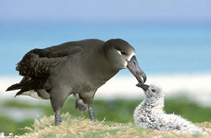
Aves |
Procellariiformes |
Diomedeidae
Umwelt: Milieu / Klimazone / Tiefenbereich / Verbreitungsgebiet
Ökologie
Others. Subtropical
Pacific Ocean and Northwest Atlantic: from the coasts of China, Japan and Russia eastward to continental North America. Tropical to temperate waters.
Länge bei der ersten Reifung / Größe / Gewicht / Alter
Geschlechtsreife: Lm ? range ? - ? cm Max length : 81.0 cm TL Männchen/unbestimmt; (Ref. 84934); max. veröff. Gewicht: 3.0 kg (Ref. 356)
Culmen: 12.7 cm; tarsus: 9.74 cm; wing: 21.3 cm.
Total Length: 68 to 74 cm (Ref. 8812). Found in the open ocean (Refs. 356, 122680). Scavengers (Ref. 356). Exhibits surface seizing behavior (Refs. 356, 122680). Courtship display preceding mating pair formation involves fanning both wings simultaneously while touching its side with its bill. Nests inland on Midway Island in calm areas; go to edge of islands and utilize updrafts to get airborne. Nesting site defended by aggression in the form of overt attack biting, threat with wide gape and vocalization, and rapid bill-clapping. Shifts between pairs in incubating eggs are long to allow far-foraging; longest recorded distance of a breeding individual of this species is 3700 km from its colony. Unable to regulate body temperature while still in the egg, even in late-incubation embryos with pip-holes; hatchlings, however, are able to regulate body temperature in response to environmental conditions. Semi-precocial. Postfledging care about 40 days. High mercury levels on feathers of young from Midway, north Pacific Ocean. Vulnerable to long-line fisheries (Ref. 87784)
Lebenszyklus und Paarungsverhalten
Geschlechtsreife | Fortpflanzung | Ablaichen | Eier | Fruchtbarkeit | Larven
Breeding starts later in October characterized by the arrival of the birds on the land. Eggs are laid from middle of November to the first week of December, incubation lasts for 66 days and most have hatched by the end of January. At least one parent was observed to guard the chick until mid-March. Parents were observed to circle around mostly at the sea between April and May and return to land only to feed the fledgling. By the end of July most birds were observed to have departed the islands.
Lepage, D. 2007 Avibase -the World Bird Database. http://www.bsc-eoc.org/avibase/avibase.jsp [accessed 09/07/2007]. (Ref. 7816)
IUCN Rote Liste Status
(Ref. 130435: Version 2025-2 (Global))
CITES Status (Ref. 108899)
Not Evaluated
Bedrohung für Menschen
Nutzung durch Menschen
FAO - Publication: search | FishSource |
Tools
Mehr Information
PopulationsdynamikWachstumMax. Alter/GrößenLänge-Gewicht-Rel.Länge-Länge-Verhältnis.LängenhäufigkeitenMassenkonvertierungDichte LebenszyklusFortpflanzungGeschlechtsreifeFruchtbarkeitAblaichenEierEientwicklungLarven PhysiologieSauerstoffverbrauch
MenschenbezogenBriefmarken, Münzen, Verschiedenes.
Internet Quellen
Schätzungen auf der Grundlage von Modellen
Anfälligkeit der Fischerei
(Ref. 71543) |
Moderate to high vulnerability (52 of 100). |
Preiskategorie
(Ref. 80766): |
Unknown. |