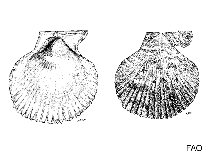
Bivalvia |
Pectinida |
Pectinidae
Lingkungan: lingkungan / zona iklim / kisaran kedalaman / jangkauan distribusi
Ekologi
Sessile; kisaran kedalaman 1 - 270 m (Acuan 87801), usually 70 - 120 m (Acuan 114844). Subtropical, preferred 8°C (Acuan 107945); 26°S - 65°S, 110°W - 53°W
Southeast Pacific, Southwest Atlantic and Antarctic: Magellanic biogeographic province. In the Pacific from Puerto Montt to Strait of Magellan and Cape Horn (56°S) to the Atlantic northwards to Rio de la Plata estuary (35°S). Also from Palmer Archipelago, Antarctica and Easter Island. Introduced in the Mediterranean. Subtropical to polar.
Panjang pada saat jatuh tempo pertama / Ukuran / Berat / umur
Kematangan: Lm ? range ? - ? cm Max length : 7.8 cm SHL jantan/; (Acuan 83435)
The Patagonian scallop fishery of this species has been certified by the Marine Stewardship Council (http://www.msc.org/) as well-managed and sustainable (http://www.msc.org/html/content_1294.htm). This is an epifaunal species found at depths of 1 to 270 meters. Adults live on the bottom supported by their right valve while juveniles appear as epibionts of algae and other invertebrates. Single species found in shallow waters and forms large banks in deeper waters. Larvae are free-living (Ref. 87801). It is found in forests of Macrocystis pyrifera (Ref. 92889).
Siklus hidup dan perilaku kawin
Kematangan | Reproduksi, perkembang biakan | Pemijahan | telur-telur | Fekunditas | Larva
Members of the class Bivalvia are mostly gonochoric, some are protandric hermaphrodites. Life cycle: Embryos develop into free-swimming trocophore larvae, succeeded by the bivalve veliger, resembling a miniature clam.
rujukan utama
Acuan | Koordinator | mitra
Rosenberg, G. 2009 Malacolog 4.1.1: A Database of Western Atlantic Marine Mollusca. [WWW database (version 4.1.1)] URL http://www.malacolog.org/. (Acuan 83435)
Status IUCN Red List
(Acuan 130435: Version 2025-2 (Global))
status CITES (Acuan 108899)
Not Evaluated
Not Evaluated
ancaman kepada manusia
Harmless
penggunaan manusia
Perikanan: komersial
FAO - Perikanan: landings search; Publication: search | FishSource | Laut di Sekitar Kita
Alat, peralatan
informasi lanjut
FisiologiKonsumsi oksigen
Yang berhubungan dengan manusiaPerangko, koin, dll.
Sumber internet
Estimasi berdasarkan model
Daya lenting
(Ref. 69278): |
Tinggi, Waktu penggandaan populasi minimum kurang dari 15 bulan (K=0.19-0.62) |
Rate of population increase
|
Prior r = 0.57, 95% CL = 0.37 - 0.85, Based on 1 data-limited stock assessment. |
Kerentanan Penangkapan Ikan
(Acuan 71543) |
Moderate vulnerability (41 of 100). |
Kerentanan Iklim
(Acuan 125649) |
High vulnerability (62 of 100) |
kategori harga
(Acuan 80766): |
Medium. |
Nutrients
|
Calcium = 149 [71, 228] mg/100g; Iron = 8.53 [1.95, 15.11] mg/100g; Protein = 9.88 [8.64, 11.12] %; Omega3 = 0.313 [0.202, 0.423] g/100g; Selenium = 61 [50, 72] μg/100g; VitaminA = 0 μg/100g; Zinc = 2.04 [0.56, 3.51] mg/100g (wet weight); based on nutrient studies. |