Bivalvia |
Pectinida |
Pectinidae
Entorno: milieu / zona climática / rango de profundidad / gama de distribución
Ecología
Sessile; rango de profundidad 1 - 270 m (Referencia 87801), usually 70 - 120 m (Referencia 114844). Subtropical, preferred 8°C (Referencia 107945); 26°S - 65°S, 110°W - 53°W
Southeast Pacific, Southwest Atlantic and Antarctic: Magellanic biogeographic province. In the Pacific from Puerto Montt to Strait of Magellan and Cape Horn (56°S) to the Atlantic northwards to Rio de la Plata estuary (35°S). Also from Palmer Archipelago, Antarctica and Easter Island. Introduced in the Mediterranean. Subtropical to polar.
Longitud en la primera madurez / Tamaño / Peso / Edad
Madurez: Lm ? range ? - ? cm Max length : 7.8 cm SHL macho / no sexado; (Referencia 83435)
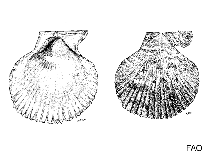
The Patagonian scallop fishery of this species has been certified by the Marine Stewardship Council (http://www.msc.org/) as well-managed and sustainable (http://www.msc.org/html/content_1294.htm). This is an epifaunal species found at depths of 1 to 270 meters. Adults live on the bottom supported by their right valve while juveniles appear as epibionts of algae and other invertebrates. Single species found in shallow waters and forms large banks in deeper waters. Larvae are free-living (Ref. 87801). It is found in forests of Macrocystis pyrifera (Ref. 92889).
Ciclo vital y comportamiento de apareamiento
Madurez | Reproducción | Puesta | Huevos | Fecundidad | Larva
Members of the class Bivalvia are mostly gonochoric, some are protandric hermaphrodites. Life cycle: Embryos develop into free-swimming trocophore larvae, succeeded by the bivalve veliger, resembling a miniature clam.
Rosenberg, G. 2009 Malacolog 4.1.1: A Database of Western Atlantic Marine Mollusca. [WWW database (version 4.1.1)] URL http://www.malacolog.org/. (Referencia 83435)
Situación en la Lista Roja de la UICN
(Referencia 130435: Version 2025-2 (Global))
Estatus CITES (Referencia 108899)
Not Evaluated
CMS (Referencia 116361)
Not Evaluated
Amenaza para el ser humano
Harmless
Usos humanos
Pesquerías: comercial
FAO - pesquerías: landings search; Publication: search | FishSource | Sea Around Us
Herramientas
Más información
Ciclo de vidaReproducciónMadurezFecundidadPuestaHuevosDesarrollo de los huevosLarva FisiologíaConsumo del oxígeno
Relacionados con el ser humanoSellos, monedas, varios
Fuentes de Internet
Estimaciones basadas en modelos
Resiliencia
(Ref. 69278): |
Alto, población duplicada en un tiempo mínimo inferior a 15 meses (K=0.19-0.62) |
Rate of population increase
|
Prior r = 0.57, 95% CL = 0.37 - 0.85, Based on 1 data-limited stock assessment. |
Vulnerabilidad pesquera
(Referencia 71543) |
Moderate vulnerability (41 of 100). |
Vulnerabilidad climática
(Referencia 125649) |
High vulnerability (62 of 100) |
Categoría de precios
(Referencia 80766): |
Medium. |
Nutrients
|
Calcium = 149 [71, 228] mg/100g; Iron = 8.53 [1.95, 15.11] mg/100g; Protein = 9.88 [8.64, 11.12] %; Omega3 = 0.313 [0.202, 0.423] g/100g; Selenium = 61 [50, 72] μg/100g; VitaminA = 0 μg/100g; Zinc = 2.04 [0.56, 3.51] mg/100g (wet weight); based on nutrient studies. |