Polychaeta |
Echiuroidea |
Bonelliidae
Miljö: miljö / Klimatzon / djupintervall / distributionsområde
Ekologi
Benthic. Subtropical
Arctic, Northeast Atlantic and the Mediterranean: Sweden, Norway, Ireland and Malta.
Längd vid första mognad / Storlek / Vikt / Ålder
Könsmognad: Lm ? range ? - ? cm Max length : 15.0 cm TL hane/ej könsbestämd; (Ref. 358)
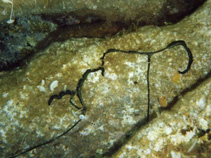
The worm is provided with an appendix; is located on the head; or misleads, which, deployed, conferred on the species a size of about 150 cm, forked in its end, of a scale of 50 cm and whose edges are corrugated. Body: plum shape; 15 cm length. Males and females have an extremely different morphology. The males: 0.1- 0.3 cm length: they have neither horn nor intestine; and live in parasite in the esophagus of the female: only one can lodge some up to 85 (Ref. 358).
Infralittoral zone; lives on hard bottoms, (Ref. 772) in anfractuosities and excavations on hard funds, interstices between stones and rollers. Females always seen occupying anfractuosities of rocks or all other benthic niche. For nourishment, they use horns equipped to palpate ground and consume microorganisms or organic matter of various origins. Nutritive particle coated with mucus before being introduced (Ref. 358). Sex of the larvae swimmer not given of start: if one larva comes into contact with horn of female, it is introduced as food particle; inside body of this female, hormonal processes make larva evolve into nanifié male. If on the contrary it manages to take refuge in anfractuosities, larva evolves into female. This mode of development guarantees a balanced population (Ref. 358). Habitat: Anfractuosities and excavations on hard funds, interstices between the stones and rollers. Biology: at the Bonellia sp. kind, the sexual dimorphism is very marked: males and females have an extremely different morphology. It is always the female of the species which one sees in nature, occupying an anfractuosities of the rock or all other benthic niche. To nourish themselves: Uses the horn equipped to palpate the ground and to consume of them the micro-organisms or the organic matter of various origins. Nutritive particles: Coated with mucus before being introduced. The disturbed animal retracts this body completely. The males: 0.1 to 0.3 cm length: they have neither horn nor intestine; female: only one can lodge some up to 85 (Ref. 358). Lives on hard bottoms in the infralittoral zone (Ref. 772).
Livscykel och parningsbeteende
Könsmognad | Reproduktion | Lek | Ägg | Fekunditet | Larver
The sex of the larvae swimmer is not given of start: if one as of the these larvae comes into contact with the horn of a female, it will be introduced as well as a food particle; inside the body of this female, hormonal processes make evolve/move this larva in nanifié male. If on the contrary it manages to take refuge in an anfractuosities, the larva evolves/moves in female. This mode of development guarantees a balanced population (Ref. 358).
Göthel, H. 1992 Guide de la faune sous-marine: La Méditerranée. Invertébrés marins et poissons. Eygen Ulmer GmbH & Co. 318 p. (Ref. 358)
Status på IUCN:s rödlista
(Ref. 130435: Version 2025-2 (Global))
CITES-status (Ref. 108899)
Not Evaluated
Not Evaluated
Hot mot människor
Mänskliga användningsområden
FAO - Publication: search | FishSource |
Verktyg
Ytterligare information
Trofisk ekologiLivsmedelsartiklar (preys)
Födosammansättning
Födointag
Predatorer
LivscykelReproduktionKönsmognadFekunditetLekÄggUtveckling av äggLarver MänniskorelateradFrimärken, mynt, diverse.
Internet-källor
Uppskattningar baserade på modeller
Sårbarhet i fisket
(Ref. 71543) |
Low vulnerability (10 of 100). |
Priskategori
(Ref. 80766): |
Unknown. |