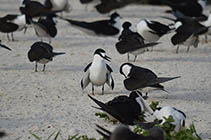
Aves |
Charadriiformes |
Laridae
Entorno: milieu / zona climática / rango de profundidad / gama de distribución
Ecología
Pelágico. Tropical; 35°N - 40°S (Referencia 96995)
Indo-Pacific, Atlantic Ocean and the Mediterranean.
Longitud en la primera madurez / Tamaño / Peso / Edad
Madurez: Lm ? range ? - ? cm Max length : 45.0 cm TL macho / no sexado; (Referencia 8812); peso máximo publicado: 180.00 g (Referencia 356); edad máxima reportada: 36 años (Referencia 8545)
Culmen: 4.53 cm; tarsus: 2.52 cm; wing: 30.5 cm.
Total Length: 43 to 45 cm; Wingspan: 86 to 94 cm (Ref. 8812). Pelagic (Ref. 122680). Coastal and oceanic islands, and offshore (Ref. 356). In beach, shoreline and pelagic zone (Ref. 116102). Pantropic, pelagic species. Strong flyer, high over the ocean. Forms large breeding colonies on tropical and subtropical islands on sand, coral and rock, with or without vegetation. Forages in flocks (Ref. 84934). Remains 10 to 20 m above water then descends and wheels in circles before grabbing its food (Ref. 356). Feeding techniques: air dipping and contact dipping from the water surface (Refs. 356, 96995). Diet consists of squid, goatfish, flyingfish and mackerel scad (Ref. 122680). Does not plunge dive and rarely stays long in water as plumage is not waterproof. Colonies may suffer heavy losses of eggs by predatory cats (Ref. 84934).
Ciclo vital y comportamiento de apareamiento
Madurez | Reproducción | Puesta | Huevos | Fecundidad | Larva
Birds go to the island at night, 3 months before laying. Hatching peaks in the middle of April. Most fledging shows in June and leave the island at the beginning of August while the adults leave at the end of August (Ref. 96995).
Lepage, D. 2007 Avibase -the World Bird Database. http://www.bsc-eoc.org/avibase/avibase.jsp [accessed 09/07/2007]. (Referencia 7816)
Situación en la Lista Roja de la UICN
(Referencia 130435: Version 2025-2 (Global))
Estatus CITES (Referencia 108899)
Not Evaluated
CMS (Referencia 116361)
Not Evaluated
Amenaza para el ser humano
Usos humanos
FAO - Publication: search | FishSource |
Herramientas
Más información
FisiologíaConsumo del oxígeno
Relacionados con el ser humanoSellos, monedas, varios
Fuentes de Internet
Estimaciones basadas en modelos
Resiliencia
(Ref. 69278): |
Alto, población duplicada en un tiempo mínimo inferior a 15 meses (K=5.28; tm=3; tmax=36) |
Vulnerabilidad pesquera
(Referencia 71543) |
High vulnerability (63 of 100). |
Categoría de precios
(Referencia 80766): |
Unknown. |