Gastropoda |
Trochida |
Tegulidae
Environnement : milieu / zone climatique / profondeur / gamme de distribution
Écologie
Benthic. Subtropical
Eastern Pacific: British Columbia, Canada to Mexico.
Longueur à la première maturité / Taille / Poids / Âge
Maturité: Lm ? range ? - ? cm Max length : 3.0 cm SHD mâle / non sexé; (Réf. 95344); common length : 2.5 cm TL mâle / non sexé; (Réf. 312); âge max. reporté: 28 années (Réf. 2823)
Description synthétique
Morphologie
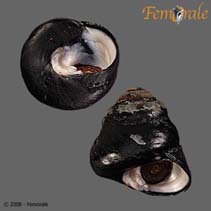
Shell is thick and dark purple to black; foot is black on the sides (Ref. 312).
It has a shell length of 2.5 cm. Fisheries: Over-harvesting for food in the early 1900s, mainly by Southern European immigrants, caused a drastic drop in population numbers. Today they are still harvested by both Americans of Southern European and Asian ancestries; heavy regulation by the Department of Fish and Game has allowed populations to recover (Ref. 312). Habitat: Occurs in high to middle intertidal zones on rocky surfaces or in pools not covered in algae. Diet: eats many species of algae including micro and macroscopic. Life span: up to 25 years (Ref. 312).
Cycle de vie et comportement reproducteur
Maturité | Reproduction | Frai | Œufs | Fécondité | Larves
Members of the order Archaeogastropoda are mostly gonochoric and broadcast spawners. Life cycle: Embryos develop into planktonic trocophore larvae and later into juvenile veligers before becoming fully grown adults.
Gallivan, G. and J. Danforth 1999 Phylum Mollusca. Marine Science Institute. (Réf. 312)
Statut dans la liste rouge de l'IUCN
(Réf. 130435: Version 2025-2 (Global))
statut CITES (Réf. 108899)
Not Evaluated
Not Evaluated
Menace pour l'homme
Utilisations par l'homme
FAO - Publication: search | FishSource |
Outils
Plus d'informations
Écologie trophiqueAliments (proies)Composition du régime alimentaireConsommation alimentairePrédateurs Dynamique des populationsCroissanceÂges / tailles maximalesLongueur-poids rel.Rel. longueur-longueur.Fréquences de longueursConversion de masseAbondance Cycle de vieReproductionMaturitéFéconditéFraiŒufsDéveloppement de l'œufLarves PhysiologieConsommation d'oxygène
Liées à l'hommeTimbres, pièces de monnaie, divers
Sources Internet
Estimations basées sur des modèles
Vulnérabilité de la pêche
(Réf. 71543) |
Moderate vulnerability (45 of 100). |
Catégorie de prix
(Réf. 80766): |
Unknown. |