Gastropoda |
Trochida |
Tegulidae
Miljö: miljö / Klimatzon / djupintervall / distributionsområde
Ekologi
Benthic. Subtropical
Eastern Pacific: British Columbia, Canada to Mexico.
Längd vid första mognad / Storlek / Vikt / Ålder
Könsmognad: Lm ? range ? - ? cm Max length : 3.0 cm SHD hane/ej könsbestämd; (Ref. 95344); common length : 2.5 cm TL hane/ej könsbestämd; (Ref. 312); rapporterad maxålder: 28 år (Ref. 2823)
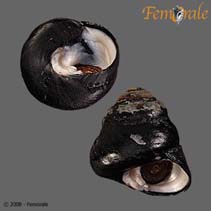
Shell is thick and dark purple to black; foot is black on the sides (Ref. 312).
It has a shell length of 2.5 cm. Fisheries: Over-harvesting for food in the early 1900s, mainly by Southern European immigrants, caused a drastic drop in population numbers. Today they are still harvested by both Americans of Southern European and Asian ancestries; heavy regulation by the Department of Fish and Game has allowed populations to recover (Ref. 312). Habitat: Occurs in high to middle intertidal zones on rocky surfaces or in pools not covered in algae. Diet: eats many species of algae including micro and macroscopic. Life span: up to 25 years (Ref. 312).
Livscykel och parningsbeteende
Könsmognad | Reproduktion | Lek | Ägg | Fekunditet | Larver
Members of the order Archaeogastropoda are mostly gonochoric and broadcast spawners. Life cycle: Embryos develop into planktonic trocophore larvae and later into juvenile veligers before becoming fully grown adults.
Gallivan, G. and J. Danforth 1999 Phylum Mollusca. Marine Science Institute. (Ref. 312)
Status på IUCN:s rödlista
(Ref. 130435: Version 2025-2 (Global))
CITES-status (Ref. 108899)
Not Evaluated
Not Evaluated
Hot mot människor
Mänskliga användningsområden
FAO - Publication: search | FishSource |
Verktyg
Ytterligare information
Trofisk ekologiLivsmedelsartiklar (preys)FödosammansättningFödointagPredatorer LivscykelReproduktionKönsmognadFekunditetLekÄggUtveckling av äggLarver MänniskorelateradFrimärken, mynt, diverse.
Internet-källor
Uppskattningar baserade på modeller
Sårbarhet i fisket
(Ref. 71543) |
Moderate vulnerability (45 of 100). |
Priskategori
(Ref. 80766): |
Unknown. |