Bivalvia |
Adapedonta |
Hiatellidae
Milieu: milieu / Klimaatzone / Diepte / verspreidingsgebied
Ecologie
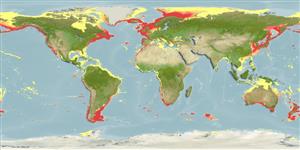
Benthic; brak water; diepte 0 - 800 m (Ref. 95344), usually 0 - 40 m (Ref. 75831). Temperate; 85°N - 79°S, 180°W - 180°E
Circumglobal. Temperate to polar.
Lengte bij maturiteit / Grootte / Gewicht / Leeftijd
Maturiteit: Lm ? range ? - ? cm Max length : 5.0 cm SHL mannelijk / geslacht onbekend; (Ref. 95344)
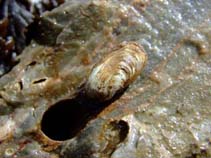
Benthic. It is found in forests of Macrocystis pyrifera (Ref. 92889). Found on sand/sandy sediments and rubble (Refs. 93550, 93290) in reefs (Ref. 3209). Inhabits the intertidal zone, attached by byssus on algal holdfasts, mussel mats, in empty burrows of rock boring bivalves (Ref. 5344'>95344, 93290). Inhabits hard bottoms (Ref. 2780), found nestling in rocks and other solid objects (Ref. 53). Free-living (Refs. 3123, 93290). Specimens were taken from logs washed up on the beaches (Ref. 88739). Suspension feeder (Ref. 66387). Reported from Hong Kong to be found on the ceilings and walls of submarine caves (Ref. 126058).
Levenscyclus en paargedrag
Maturiteit | Voortplanting | Paaien | Eieren | Fecunditeit | Larven
Members of the class Bivalvia are mostly gonochoric, some are protandric hermaphrodites. Life cycle: Embryos develop into free-swimming trocophore larvae, succeeded by the bivalve veliger, resembling a miniature clam.
Raines, B. and M. Huber 2012 Biodiversity quadrupled - Revision of Eatser Island and Salas y Gómez bivalves. Zootaxa 3217:1-106. (Ref. 93550)
Status op de Rode Lijst van het IUCN
(Ref. 130435: Version 2025-2 (Global))
CITES status (Ref. 108899)
Not Evaluated
Not Evaluated
Gevaar voor de mens
Gebruik door de mens
FAO - Publication: search | FishSource |
Tools
Meer informatie
Trofische ecologieVoedsel (prooien)DieetsamenstellingVoedselconsumptiePredatoren LevenscyclusVoortplantingMaturiteitFecunditeitPaaienEierenOntwikkeling van de eierenLarven FysiologieZuurstofverbruik
Menselijk gerelateerdPostzegels, munten, diversen.
Internetbronnen
Schattingen op basis van modellen
Weerstandsvermogen
(Ref. 69278): |
laag, minimale populatieverdubbelingstijd 4,5-14 jaar (K=0.14) |
Kwetsbaarheid van de visserij
(Ref. 71543) |
Moderate vulnerability (40 of 100). |
Prijsklasse
(Ref. 80766): |
Unknown. |