Bivalvia |
Adapedonta |
Hiatellidae
Miljö: miljö / Klimatzon / djupintervall / distributionsområde
Ekologi
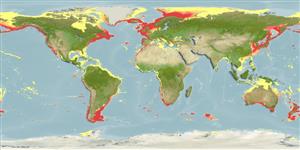
Benthic; brackvatten; djupintervall 0 - 800 m (Ref. 95344), usually 0 - 40 m (Ref. 75831). Temperate; 85°N - 79°S, 180°W - 180°E
Circumglobal. Temperate to polar.
Längd vid första mognad / Storlek / Vikt / Ålder
Könsmognad: Lm ? range ? - ? cm Max length : 5.0 cm SHL hane/ej könsbestämd; (Ref. 95344)
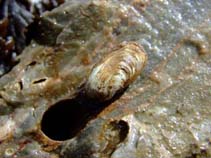
Benthic. It is found in forests of Macrocystis pyrifera (Ref. 92889). Found on sand/sandy sediments and rubble (Refs. 93550, 93290) in reefs (Ref. 3209). Inhabits the intertidal zone, attached by byssus on algal holdfasts, mussel mats, in empty burrows of rock boring bivalves (Ref. 5344'>95344, 93290). Inhabits hard bottoms (Ref. 2780), found nestling in rocks and other solid objects (Ref. 53). Free-living (Refs. 3123, 93290). Specimens were taken from logs washed up on the beaches (Ref. 88739). Suspension feeder (Ref. 66387). Reported from Hong Kong to be found on the ceilings and walls of submarine caves (Ref. 126058).
Livscykel och parningsbeteende
Könsmognad | Reproduktion | Lek | Ägg | Fekunditet | Larver
Members of the class Bivalvia are mostly gonochoric, some are protandric hermaphrodites. Life cycle: Embryos develop into free-swimming trocophore larvae, succeeded by the bivalve veliger, resembling a miniature clam.
Raines, B. and M. Huber 2012 Biodiversity quadrupled - Revision of Eatser Island and Salas y Gómez bivalves. Zootaxa 3217:1-106. (Ref. 93550)
Status på IUCN:s rödlista
(Ref. 130435: Version 2025-2 (Global))
CITES-status (Ref. 108899)
Not Evaluated
Not Evaluated
Hot mot människor
Mänskliga användningsområden
FAO - Publication: search | FishSource |
Verktyg
Ytterligare information
Trofisk ekologiLivsmedelsartiklar (preys)FödosammansättningFödointagPredatorer LivscykelReproduktionKönsmognadFekunditetLekÄggUtveckling av äggLarver MänniskorelateradFrimärken, mynt, diverse.
Internet-källor
Uppskattningar baserade på modeller
Resiliens
(Ref. 69278): |
Låg, lägsta populationsfördubblingstid 4,5-14 år (K=0.14) |
Sårbarhet i fisket
(Ref. 71543) |
Moderate vulnerability (40 of 100). |
Priskategori
(Ref. 80766): |
Unknown. |