Bivalvia |
Adapedonta |
Hiatellidae
Environnement : milieu / zone climatique / profondeur / gamme de distribution
Écologie
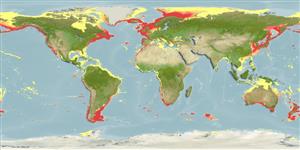
Benthic; saumâtre; profondeur 0 - 800 m (Réf. 95344), usually 0 - 40 m (Réf. 75831). Temperate; 85°N - 79°S, 180°W - 180°E
Circumglobal. Temperate to polar.
Longueur à la première maturité / Taille / Poids / Âge
Maturité: Lm ? range ? - ? cm Max length : 5.0 cm SHL mâle / non sexé; (Réf. 95344)
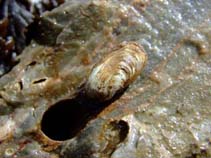
Benthic. It is found in forests of Macrocystis pyrifera (Ref. 92889). Found on sand/sandy sediments and rubble (Refs. 93550, 93290) in reefs (Ref. 3209). Inhabits the intertidal zone, attached by byssus on algal holdfasts, mussel mats, in empty burrows of rock boring bivalves (Ref. 5344'>95344, 93290). Inhabits hard bottoms (Ref. 2780), found nestling in rocks and other solid objects (Ref. 53). Free-living (Refs. 3123, 93290). Specimens were taken from logs washed up on the beaches (Ref. 88739). Suspension feeder (Ref. 66387). Reported from Hong Kong to be found on the ceilings and walls of submarine caves (Ref. 126058).
Cycle de vie et comportement reproducteur
Maturité | Reproduction | Frai | Œufs | Fécondité | Larves
Members of the class Bivalvia are mostly gonochoric, some are protandric hermaphrodites. Life cycle: Embryos develop into free-swimming trocophore larvae, succeeded by the bivalve veliger, resembling a miniature clam.
Raines, B. and M. Huber 2012 Biodiversity quadrupled - Revision of Eatser Island and Salas y Gómez bivalves. Zootaxa 3217:1-106. (Réf. 93550)
Statut dans la liste rouge de l'IUCN
(Réf. 130435: Version 2025-2 (Global))
statut CITES (Réf. 108899)
Not Evaluated
Not Evaluated
Menace pour l'homme
Utilisations par l'homme
FAO - Publication: search | FishSource |
Outils
Plus d'informations
Écologie trophiqueAliments (proies)Composition du régime alimentaireConsommation alimentairePrédateurs Dynamique des populations Cycle de vieReproductionMaturitéFéconditéFraiŒufsDéveloppement de l'œufLarves PhysiologieConsommation d'oxygène
Liées à l'hommeTimbres, pièces de monnaie, divers
Sources Internet
Estimations basées sur des modèles
Résilience
(Ref. 69278): |
Faible, temps minimum de doublement de population : 4,5 à 14 années (K=0.14) |
Vulnérabilité de la pêche
(Réf. 71543) |
Moderate vulnerability (40 of 100). |
Catégorie de prix
(Réf. 80766): |
Unknown. |