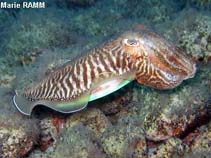
Cephalopoda |
Sepiida |
Sepiidae
पर्यावरण: पर्यावरण / जलवायु क्षेत्र / गहराई सीमा / वितरण सीमा
पारिस्थितिकी
Benthic; गहराई सीमा 0 - 242 m (संदर्भ 1695), usually 0 - 50 m (संदर्भ 88010). Tropical, preferred 21°C (संदर्भ 107945); 62°N - 4°N, 32°W - 37°E (संदर्भ 1695)
Eastern Atlantic and the Mediterranean: from the Shetlands and southern Norway (stray in the Baltic Sea), south to the Mediterranean Sea to northwestern Africa.
प्रथम परिपक्वता पर लंबाई / आकार / वज़न / आयु
परिपक्व अवधि: Lm ?, range 9 - ? cm Max length : 49.0 cm ML पुल्लिंग / अलिंग; (संदर्भ 1695); अधिकतम प्रकाशित वज़न: 4.0 kg (संदर्भ 1695)
In temperate waters, maximum mantle length is 49 cm and up to 4 kg in weight. In the subtropics, maximum mantle length is 30 cm and up to 2 kg in weight (Ref. 1695). Common size: 15.0 to 25.0 cm (West Saharan fisheries; Ref. 275). One of the most important species for cephalopod fisheries in many countries but have been observed in recent years that it is heavily fished, e.g., Mediterranean (Ref. 1695). Also, a highly valued item especially in Japan, Korea, Italy and Spain (Ref. 1695). Maximum depth range from Ref. 114857. A neritic, demersal species found in the subtidal zone to depths of 200 m, generally over sandy-muddy substrates (Ref. 1695, page 100). Presence in Portuguese waters indicates its tolerance for brackish water. Undergoes seasonal migrations between inshore waters in spring and summer and medium shelf grounds (around 100 m depth) in autumn and winter. Courtship behavior is elaborate and ritualized with visual displays and 'mate guarding'. Spawns in shallow waters, optimally between 13° to 15°C. Eggs, 8 to 10, mm diameter and blackened with ink, are attached on seaweed, shells, debris and other substrates, in grape-like clusters. Depending on water temperature, eggs hatch after 30 to 90 days. Hatchlings measure about 7 to 8 mm TL. From hatchlings to adults, exhibit light-induced burying behavior where most individuals hide in sand during the day and where prey is often ambushed. Life cycle under natural conditions, between 12 to 24 months. Feeds on small mollusks, crabs, shrimps, other cuttlefishes, and juvenile demersal fishes. Cannibalism is common. Considered one of the most commercially important cephalopod species. With potential for aquaculture. Usually marketed fresh or frozen as a highly valued food item, especially in Japan, Korea, Italy and Spain (Ref. 1695).
Male and female adults usually die shortly after spawning and brooding, respectively. Mating behavior: Males perform various displays to attract potential females for copulation. During copulation, male grasp the female and inserts the hectocotylus into the female's mantle cavity where fertilization usually occurs. Life cycle: Embryos hatch into planktonic stage and live for some time before they grow larger and take up a benthic existence as adults (Ref. 833).
Schneider, W. 1990 FAO species identification sheets for fishery purposes. Field guide to the commercial marine resources of the Gulf of Guinea. Prepared and published with the support of the FAO Regional Office for Africa. Rome: FAO. 268 p. (संदर्भ 417)
आईयूसीएन रेड लिस्ट स्थिति
(संदर्भ 130435: Version 2025-2 (Global))
CITES स्थिति (संदर्भ 108899)
Not Evaluated
CMS (संदर्भ 116361)
Not Evaluated
मनुष्यों के लिए ख़तरा
मानव उपयोग
मात्स्यिकी: व्यापारिक
FAO - Aquaculture Systems: production searchमात्स्यिकी: प्रजातियों की प्रोफ़ाइल, landings search; Publication: search | FIRMS (Stock assessments) | FishSource | हमारे चारों ओर समुद्र
साधन
अधिक जानकारी
फिजियोलॉजीप्राणवायु की खपत
मानव संबंधीटिकट, सिक्के, विविध.
इंटरनेट स्रोत
मॉडल पर आधारित अनुमान
लौटाव
(Ref. 69278): |
ऊंचा, न्यूनतम जनसंख्या दुगनी समय अवलागत 15 महीने। (K=0.58-0.63; tm=1) |
Rate of population increase
|
Prior r = 0.50, 95% CL = 0.33 - 0.76, Based on 3 full stock assessments. |
मछली पकड़ने की भेद्यता
(संदर्भ 71543) |
Low vulnerability (25 of 100). |
जलवायु भेद्यता
(संदर्भ 125649) |
Low vulnerability (4 of 100) |
मूल्य श्रेणी
(संदर्भ 80766): |
High. |
Nutrients
|
Calcium = 126 [75, 177] mg/100g; Iron = 4.79 [1.67, 7.92] mg/100g; Protein = 15.5 [13.7, 17.4] %; Omega3 = 0.414 [0.262, 0.566] g/100g; Selenium = 57.8 [48.5, 67.2] μg/100g; VitaminA = 0 μg/100g; Zinc = 1.97 [0.92, 3.02] mg/100g (wet weight); based on nutrient studies. |