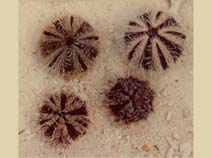
Echinoidea |
Camarodonta |
Toxopneustidae
Miljö: miljö / Klimatzon / djupintervall / distributionsområde
Ekologi
Benthic; djupintervall 0 - 75 m (Ref. 81020). Tropical; 37°N - 44°S, 30°E - 77°W
Indo-Pacific: from east Africa to southeast Asia, north to South Korea, Japan and Hawaii, south to Australia and New Zealand, to as far east as Galapagos Islands.
Längd vid första mognad / Storlek / Vikt / Ålder
Könsmognad: Lm ? range ? - ? cm Max length : 10.0 cm WD hane/ej könsbestämd; (Ref. 2968)
Intertidal to subtidal (Ref. 106729). Inhabits shallow seagrass beds at depths of 1 to 30 m (Ref. 800). Also on rubble (Ref. 106121)and coral reef areas (Refs. 106724, 106728, 106735) like reef lagoons (Ref. 106729). Tripneustes gratilla elatensis: occurs in inland salt-ponds tolerating salinities greater than 45 ppm at 15°C (Ref. 2940). Feeds on macroalgae, seagrass, diatoms and coral tissue scraped from rocks (Ref. 2944). Omnivore (Ref. 116259). Grazing species. Dwells among rocks and boulders. Utilizes floating seaweed as cover (Ref. 129602).
Livscykel och parningsbeteende
Könsmognad | Reproduktion | Lek | Ägg | Fekunditet | Larver
Members of the class Echinoidea are gonochoric. Fertilization is external. Brooding is common, eggs are held either on the peristome, around the periproct or deep into the concavities on the petaloids. Life cycle: Embryos develop into planktotrophic larvae (echinoplateus) and live for several months before they sink to the bottom using their tube feet to adhere on the ground where they metamorphose into young urchins.
Schoppe, S. 2000 A guide to common shallow water sea stars, brittle stars, sea urchins, sea cucumbers and feather stars (echinoderms) of the Philippines. Times Media Private Limited, Singapore. 144 p. (Ref. 800)
Status på IUCN:s rödlista
(Ref. 130435: Version 2025-2 (Global))
CITES-status (Ref. 108899)
Not Evaluated
Not Evaluated
Hot mot människor
Harmless
Mänskliga användningsområden
Fiskeri: kommersiell
FAO - Publication: search | FishSource | Havet omkring oss
Verktyg
Ytterligare information
MänniskorelateradFrimärken, mynt, diverse.
Internet-källor
Uppskattningar baserade på modeller
Resiliens
(Ref. 69278): |
Hög, lägsta populationsfördubblingstid mindre än 15 månader (K=0.84-1.08) |
Sårbarhet i fisket
(Ref. 71543) |
Low vulnerability (10 of 100). |
Priskategori
(Ref. 80766): |
Unknown. |
Nutrients
|
Calcium = 126 [75, 177] mg/100g; Iron = 5.08 [1.67, 7.92] mg/100g; Protein = 12%; Omega3 = 0.331 [0.263, 0.400] g/100g; Selenium = 0.04 [48.48, 67.17] μg/100g; VitaminA = 0 μg/100g; Zinc = 1.97 [0.92, 3.02] mg/100g (wet weight); based on nutrient studies. |