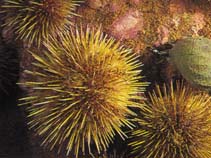
Echinoidea |
Camarodonta |
Strongylocentrotidae
البيئة: الوسط / المنطقة المناخية / نطاق العمق / نطاق التوزيع
البيئة
Benthic; نطاق العمق 0 - 300 m (مرجع 78719), usually 0 - 50 m (مرجع 113749). Temperate; 79°N - 37°N, 127°E - 97°E
Northern Pacific, Northern Atlantic and the Arctic. Temperate to polar.
الطول عند النضج الأول / الحجم / وزن / العمر
النضج: Lm 2.5 range ? - ? cm Max length : 10.0 cm WD ذكر/ مختلط الجنس; (مرجع 865); العمر: 45 سنين (مرجع 90469)
It is found on rocks and soft bottoms from the intertidal to a depth of 300 meters (Ref. 865). Also in tidepools in the low intertidal, found on bedrock outcrops, boulders, cobbles, occasionally in sand (Ref. 113749). Primarily feeds on seaweeds, with few feeding on eelgrass (Ref. 106946). Also feeds on bivalves, gastropods and benthic crustaceans (Ref. 85579).
دورة الحياة وسلوك التزاوج
النضج | التكاثر | وضع البيض | بيض | الخصوبة | اليرقات
Members of the class Echinoidea are gonochoric. Fertilization is external. Brooding is common, eggs are held either on the peristome, around the periproct or deep into the concavities on the petaloids. Life cycle: Embryos develop into planktotrophic larvae (echinoplateus) and live for several months before they sink to the bottom using their tube feet to adhere on the ground where they metamorphose into young urchins.
Berkes, F., T.P. Hughes, R.S. Steneck, J.A. Wilson, D.R. Bellwood, B. Crona, C. Folke, L.H. Gunderson, H.M. Leslie, J. Norberg, M. Nyström, P. Olsson, H. Österblom, M. Scheffer and B. Worm 2006 Globalization, roving bandits, and marine resources. Science. 311:1557-1558. (مرجع 861)
حالة القائمة الحمراء للاتحاد الدولي لحفظ الطبيعة والموارد الطبيعية
(مرجع 130435: Version 2025-2 (Global))
حالته حسب اتفاقية سايتس (مرجع 108899)
Not Evaluated
Not Evaluated
خطر للأنسان
استخدامات بشرية
مصائد: تجاري
FAO - Publication: search | FishSource | البحر حولنا
أدوات
مزيد من المعلومات
علم وظائف الأعضاءاستهلاك الأوكسجين
ذات الصلة بالبشرطوابع بريدية وعملات معدنية ومتنوعة
مصادر علي الأنترنت
تقديرات تستند إلى النماذج
المرونه
(Ref. 69278): |
عالي, الحد الزمني الأدني لتضاعف عدد أفراد المجتمع أقل من 15 شهر (K=0.12-0.84; tm=2.5; tmax=45) |
ضعف الصيد
(مرجع 71543) |
Moderate to high vulnerability (46 of 100). |
فئة السعر
(مرجع 80766): |
Medium. |
Nutrients
|
Calcium = 126 [75, 177] mg/100g; Iron = 5.08 [1.67, 7.92] mg/100g; Protein = 12%; Omega3 = 0.331 [0.263, 0.400] g/100g; Selenium = 0.04 [48.48, 67.17] μg/100g; VitaminA = 0 μg/100g; Zinc = 1.97 [0.92, 3.02] mg/100g (wet weight); based on nutrient studies. |