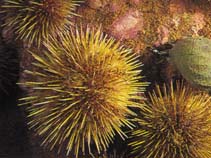
Echinoidea |
Camarodonta |
Strongylocentrotidae
Lingkungan: lingkungan / zona iklim / kisaran kedalaman / jangkauan distribusi
Ekologi
Benthic; kisaran kedalaman 0 - 300 m (Acuan 78719), usually 0 - 50 m (Acuan 113749). Temperate; 79°N - 37°N, 127°E - 97°E
Northern Pacific, Northern Atlantic and the Arctic. Temperate to polar.
Panjang pada saat jatuh tempo pertama / Ukuran / Berat / umur
Kematangan: Lm 2.5 range ? - ? cm Max length : 10.0 cm WD jantan/; (Acuan 865); Umur maksimum dilaporkan: 45 Tahun (Acuan 90469)
It is found on rocks and soft bottoms from the intertidal to a depth of 300 meters (Ref. 865). Also in tidepools in the low intertidal, found on bedrock outcrops, boulders, cobbles, occasionally in sand (Ref. 113749). Primarily feeds on seaweeds, with few feeding on eelgrass (Ref. 106946). Also feeds on bivalves, gastropods and benthic crustaceans (Ref. 85579).
Members of the class Echinoidea are gonochoric. Fertilization is external. Brooding is common, eggs are held either on the peristome, around the periproct or deep into the concavities on the petaloids. Life cycle: Embryos develop into planktotrophic larvae (echinoplateus) and live for several months before they sink to the bottom using their tube feet to adhere on the ground where they metamorphose into young urchins.
rujukan utama
Acuan | Koordinator | mitra
Berkes, F., T.P. Hughes, R.S. Steneck, J.A. Wilson, D.R. Bellwood, B. Crona, C. Folke, L.H. Gunderson, H.M. Leslie, J. Norberg, M. Nyström, P. Olsson, H. Österblom, M. Scheffer and B. Worm 2006 Globalization, roving bandits, and marine resources. Science. 311:1557-1558. (Acuan 861)
Status IUCN Red List
(Acuan 130435: Version 2025-2 (Global))
status CITES (Acuan 108899)
Not Evaluated
Not Evaluated
ancaman kepada manusia
penggunaan manusia
Perikanan: komersial
FAO - Publication: search | FishSource | Laut di Sekitar Kita
Alat, peralatan
informasi lanjut
FisiologiKonsumsi oksigen
Yang berhubungan dengan manusiaPerangko, koin, dll.
Sumber internet
Estimasi berdasarkan model
Daya lenting
(Ref. 69278): |
Tinggi, Waktu penggandaan populasi minimum kurang dari 15 bulan (K=0.12-0.84; tm=2.5; tmax=45) |
Kerentanan Penangkapan Ikan
(Acuan 71543) |
Moderate to high vulnerability (46 of 100). |
kategori harga
(Acuan 80766): |
Medium. |
Nutrients
|
Calcium = 126 [75, 177] mg/100g; Iron = 5.08 [1.67, 7.92] mg/100g; Protein = 12%; Omega3 = 0.331 [0.263, 0.400] g/100g; Selenium = 0.04 [48.48, 67.17] μg/100g; VitaminA = 0 μg/100g; Zinc = 1.97 [0.92, 3.02] mg/100g (wet weight); based on nutrient studies. |