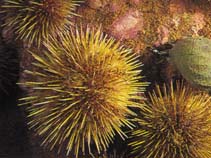
Echinoidea |
Camarodonta |
Strongylocentrotidae
Entorno: milieu / zona climática / rango de profundidad / gama de distribución
Ecología
Benthic; rango de profundidad 0 - 300 m (Referencia 78719), usually 0 - 50 m (Referencia 113749). Temperate; 79°N - 37°N, 127°E - 97°E
Northern Pacific, Northern Atlantic and the Arctic. Temperate to polar.
Longitud en la primera madurez / Tamaño / Peso / Edad
Madurez: Lm 2.5 range ? - ? cm Max length : 10.0 cm WD macho / no sexado; (Referencia 865); edad máxima reportada: 45 años (Referencia 90469)
It is found on rocks and soft bottoms from the intertidal to a depth of 300 meters (Ref. 865). Also in tidepools in the low intertidal, found on bedrock outcrops, boulders, cobbles, occasionally in sand (Ref. 113749). Primarily feeds on seaweeds, with few feeding on eelgrass (Ref. 106946). Also feeds on bivalves, gastropods and benthic crustaceans (Ref. 85579).
Ciclo vital y comportamiento de apareamiento
Madurez | Reproducción | Puesta | Huevos | Fecundidad | Larva
Members of the class Echinoidea are gonochoric. Fertilization is external. Brooding is common, eggs are held either on the peristome, around the periproct or deep into the concavities on the petaloids. Life cycle: Embryos develop into planktotrophic larvae (echinoplateus) and live for several months before they sink to the bottom using their tube feet to adhere on the ground where they metamorphose into young urchins.
Berkes, F., T.P. Hughes, R.S. Steneck, J.A. Wilson, D.R. Bellwood, B. Crona, C. Folke, L.H. Gunderson, H.M. Leslie, J. Norberg, M. Nyström, P. Olsson, H. Österblom, M. Scheffer and B. Worm 2006 Globalization, roving bandits, and marine resources. Science. 311:1557-1558. (Referencia 861)
Situación en la Lista Roja de la UICN
(Referencia 130435: Version 2025-2 (Global))
Estatus CITES (Referencia 108899)
Not Evaluated
CMS (Referencia 116361)
Not Evaluated
Amenaza para el ser humano
Usos humanos
Pesquerías: comercial
FAO - Publication: search | FishSource | Sea Around Us
Herramientas
Más información
FisiologíaConsumo del oxígeno
Relacionados con el ser humanoSellos, monedas, varios
Fuentes de Internet
Estimaciones basadas en modelos
Resiliencia
(Ref. 69278): |
Alto, población duplicada en un tiempo mínimo inferior a 15 meses (K=0.12-0.84; tm=2.5; tmax=45) |
Vulnerabilidad pesquera
(Referencia 71543) |
Moderate to high vulnerability (46 of 100). |
Categoría de precios
(Referencia 80766): |
Medium. |
Nutrients
|
Calcium = 126 [75, 177] mg/100g; Iron = 5.08 [1.67, 7.92] mg/100g; Protein = 12%; Omega3 = 0.331 [0.263, 0.400] g/100g; Selenium = 0.04 [48.48, 67.17] μg/100g; VitaminA = 0 μg/100g; Zinc = 1.97 [0.92, 3.02] mg/100g (wet weight); based on nutrient studies. |