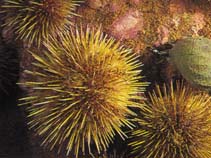
Echinoidea |
Camarodonta |
Strongylocentrotidae
Môi trường: môi trường / vùng khí hậu / Mức độ sâu / phạm vi phân phối
Sinh thái học
Benthic; mức độ sâu 0 - 300 m (Tài liệu tham khảo 78719), usually 0 - 50 m (Tài liệu tham khảo 113749). Temperate; 79°N - 37°N, 127°E - 97°E
Northern Pacific, Northern Atlantic and the Arctic. Temperate to polar.
Chiều dài lúc trưởng thành đầu tiên / Bộ gần gũi / Khối lượng (Trọng lượng) / Tuổi
Chín muồi sinh dục: Lm 2.5 range ? - ? cm Max length : 10.0 cm WD con đực/không giới tính; (Tài liệu tham khảo 865); Tuổi cực đại được báo cáo: 45 các năm (Tài liệu tham khảo 90469)
It is found on rocks and soft bottoms from the intertidal to a depth of 300 meters (Ref. 865). Also in tidepools in the low intertidal, found on bedrock outcrops, boulders, cobbles, occasionally in sand (Ref. 113749). Primarily feeds on seaweeds, with few feeding on eelgrass (Ref. 106946). Also feeds on bivalves, gastropods and benthic crustaceans (Ref. 85579).
Members of the class Echinoidea are gonochoric. Fertilization is external. Brooding is common, eggs are held either on the peristome, around the periproct or deep into the concavities on the petaloids. Life cycle: Embryos develop into planktotrophic larvae (echinoplateus) and live for several months before they sink to the bottom using their tube feet to adhere on the ground where they metamorphose into young urchins.
Berkes, F., T.P. Hughes, R.S. Steneck, J.A. Wilson, D.R. Bellwood, B. Crona, C. Folke, L.H. Gunderson, H.M. Leslie, J. Norberg, M. Nyström, P. Olsson, H. Österblom, M. Scheffer and B. Worm 2006 Globalization, roving bandits, and marine resources. Science. 311:1557-1558. (Tài liệu tham khảo 861)
Tình trạng Sách đỏ IUCN
(Tài liệu tham khảo 130435: Version 2025-2 (Global))
tình trạng CITES (Tài liệu tham khảo 108899)
Not Evaluated
CMS (Tài liệu tham khảo 116361)
Not Evaluated
Mối đe dọa đối với con người
Sử dụng của con người
Các nghề cá: tính thương mại
FAO - Publication: search | FishSource | Biển chung quanh ta
Các công cụ
Thêm thông tin
Sinh lý họcThành phần ô-xy
Liên quan đến con ngườiTem, tiền xu, v.v.
Các nguồn internet
Ước tính dựa trên mô hình
Thích nghi nhanh
(Ref. 69278): |
Chiêù cao, thời gian nhân đôi của chủng quần tối thiểu là dưới 15 tháng (K=0.12-0.84; tm=2.5; tmax=45) |
Sự dễ bị tổn thương của nghề đánh cá
(Tài liệu tham khảo 71543) |
Moderate to high vulnerability (46 of 100). |
Loại giá
(Tài liệu tham khảo 80766): |
Medium. |
Nutrients
|
Calcium = 126 [75, 177] mg/100g; Iron = 5.08 [1.67, 7.92] mg/100g; Protein = 12%; Omega3 = 0.331 [0.263, 0.400] g/100g; Selenium = 0.04 [48.48, 67.17] μg/100g; VitaminA = 0 μg/100g; Zinc = 1.97 [0.92, 3.02] mg/100g (wet weight); based on nutrient studies. |