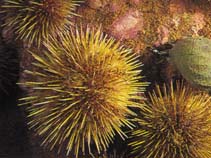
Echinoidea |
Camarodonta |
Strongylocentrotidae
Environnement : milieu / zone climatique / profondeur / gamme de distribution
Écologie
Benthic; profondeur 0 - 300 m (Réf. 78719), usually 0 - 50 m (Réf. 113749). Temperate; 79°N - 37°N, 127°E - 97°E
Northern Pacific, Northern Atlantic and the Arctic. Temperate to polar.
Longueur à la première maturité / Taille / Poids / Âge
Maturité: Lm 2.5 range ? - ? cm Max length : 10.0 cm WD mâle / non sexé; (Réf. 865); âge max. reporté: 45 années (Réf. 90469)
It is found on rocks and soft bottoms from the intertidal to a depth of 300 meters (Ref. 865). Also in tidepools in the low intertidal, found on bedrock outcrops, boulders, cobbles, occasionally in sand (Ref. 113749). Primarily feeds on seaweeds, with few feeding on eelgrass (Ref. 106946). Also feeds on bivalves, gastropods and benthic crustaceans (Ref. 85579).
Cycle de vie et comportement reproducteur
Maturité | Reproduction | Frai | Œufs | Fécondité | Larves
Members of the class Echinoidea are gonochoric. Fertilization is external. Brooding is common, eggs are held either on the peristome, around the periproct or deep into the concavities on the petaloids. Life cycle: Embryos develop into planktotrophic larvae (echinoplateus) and live for several months before they sink to the bottom using their tube feet to adhere on the ground where they metamorphose into young urchins.
Berkes, F., T.P. Hughes, R.S. Steneck, J.A. Wilson, D.R. Bellwood, B. Crona, C. Folke, L.H. Gunderson, H.M. Leslie, J. Norberg, M. Nyström, P. Olsson, H. Österblom, M. Scheffer and B. Worm 2006 Globalization, roving bandits, and marine resources. Science. 311:1557-1558. (Réf. 861)
Statut dans la liste rouge de l'IUCN
(Réf. 130435: Version 2025-2 (Global))
statut CITES (Réf. 108899)
Not Evaluated
Not Evaluated
Menace pour l'homme
Utilisations par l'homme
Pêcheries: commercial
FAO - Publication: search | FishSource | Sea Around Us
Outils
Plus d'informations
Dynamique des populations PhysiologieConsommation d'oxygène
Liées à l'hommeTimbres, pièces de monnaie, divers
Sources Internet
Estimations basées sur des modèles
Résilience
(Ref. 69278): |
Haut, temps minimum de doublement de population inférieur à 15 mois (K=0.12-0.84; tm=2.5; tmax=45) |
Vulnérabilité de la pêche
(Réf. 71543) |
Moderate to high vulnerability (46 of 100). |
Catégorie de prix
(Réf. 80766): |
Medium. |
Nutrients
|
Calcium = 126 [75, 177] mg/100g; Iron = 5.08 [1.67, 7.92] mg/100g; Protein = 12%; Omega3 = 0.331 [0.263, 0.400] g/100g; Selenium = 0.04 [48.48, 67.17] μg/100g; VitaminA = 0 μg/100g; Zinc = 1.97 [0.92, 3.02] mg/100g (wet weight); based on nutrient studies. |