Holothuroidea |
Synallactida |
Stichopodidae
पर्यावरण: पर्यावरण / जलवायु क्षेत्र / गहराई सीमा / वितरण सीमा
पारिस्थितिकी
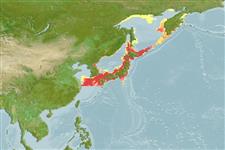
Benthic; गहराई सीमा 0 - 200 m (संदर्भ 635), usually 50 - 100 m (संदर्भ 635). Subtropical; ? - 30°C (संदर्भ 77134), preferred 16°C (संदर्भ 107945); 63°N - 31°N, 117°E - 165°E (संदर्भ 112755)
Northwest Pacific: Japan (from Hokkaido to Kyushu), China, Korean Peninsula and Far Eastern Russia (Karaginskogo Island).
प्रथम परिपक्वता पर लंबाई / आकार / वज़न / आयु
परिपक्व अवधि: Lm ?, range 20 - ? cm Max length : 30.0 cm TL पुल्लिंग / अलिंग; (संदर्भ 101467)
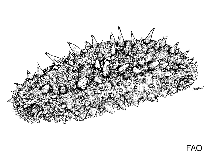
Common in shallow coastal bottom communities from the intertidal zone to depths more than 100 m. Forms aggregations, usually in the upper sublittoral zone (Ref. 635). May occur in three color variants: red type often found in offshore gravel beds while the green and black types often at inshore sandy-muddy bottoms (Ref. 77132). Juveniles often associated with algal/seagrass and oyster beds (Ref. 621). Most commercially important sea cucumber species (for trade, food and traditional medicine both; fisheries and farming/ranching) in China (Ref. 77133). Aquaculture now widespread in northern coast of China (Ref. 77133) since wild populations became over-exploited in the 1990s. Chinese aquaculture production peaked at 65,283 tons in 2005 (Ref. 77133). A sediment-feeder and bio-scavenger; ingests organic matter in sediment, e.g., bacteria, protozoa, diatoms, plant and animal debris including faeces (Ref. 77143).
Members of the class Holothuroidea are gonochoric and have only one gonad. Spawning and fertilization are both external and some exhibit brooding. Life cycle: Embryos develop into planktotrophic larvae (auricularia) then into doliolaria (barrel-shaped stage) which later metamorphose into juvenile sea cucumbers.
Kan-no, M. and A. Kijima 2003 Genetic differentiation among three color variants of Japanese sea cucumber Stichopus jamponicus. Fisheries Science 69:806-812. (संदर्भ 77132)
आईयूसीएन रेड लिस्ट स्थिति
(संदर्भ 130435: Version 2025-2 (Global))
CITES स्थिति (संदर्भ 108899)
Not Evaluated
CMS (संदर्भ 116361)
Not Evaluated
मनुष्यों के लिए ख़तरा
Harmless
मानव उपयोग
मात्स्यिकी: व्यापारिक; जलीयकृषि: व्यापारिक
FAO - Aquaculture Systems: प्रजातियों की प्रोफ़ाइल, production search; मात्स्यिकी: landings search; Publication: search | FishSource | हमारे चारों ओर समुद्र
साधन
अधिक जानकारी
फिजियोलॉजीप्राणवायु की खपत
मानव संबंधीटिकट, सिक्के, विविध.
इंटरनेट स्रोत
मॉडल पर आधारित अनुमान
मछली पकड़ने की भेद्यता
(संदर्भ 71543) |
Low to moderate vulnerability (35 of 100). |
जलवायु भेद्यता
(संदर्भ 125649) |
Low vulnerability (8 of 100) |
मूल्य श्रेणी
(संदर्भ 80766): |
High. |
Nutrients
|
Calcium = 126 [75, 177] mg/100g; Iron = 4.79 [1.67, 7.92] mg/100g; Protein = 16.6 [15.4, 17.8] %; Omega3 = 0.331 [0.263, 0.400] g/100g; Selenium = 57.8 [48.5, 67.2] μg/100g; VitaminA = 0 μg/100g; Zinc = 1.97 [0.92, 3.02] mg/100g (wet weight); based on nutrient studies. |